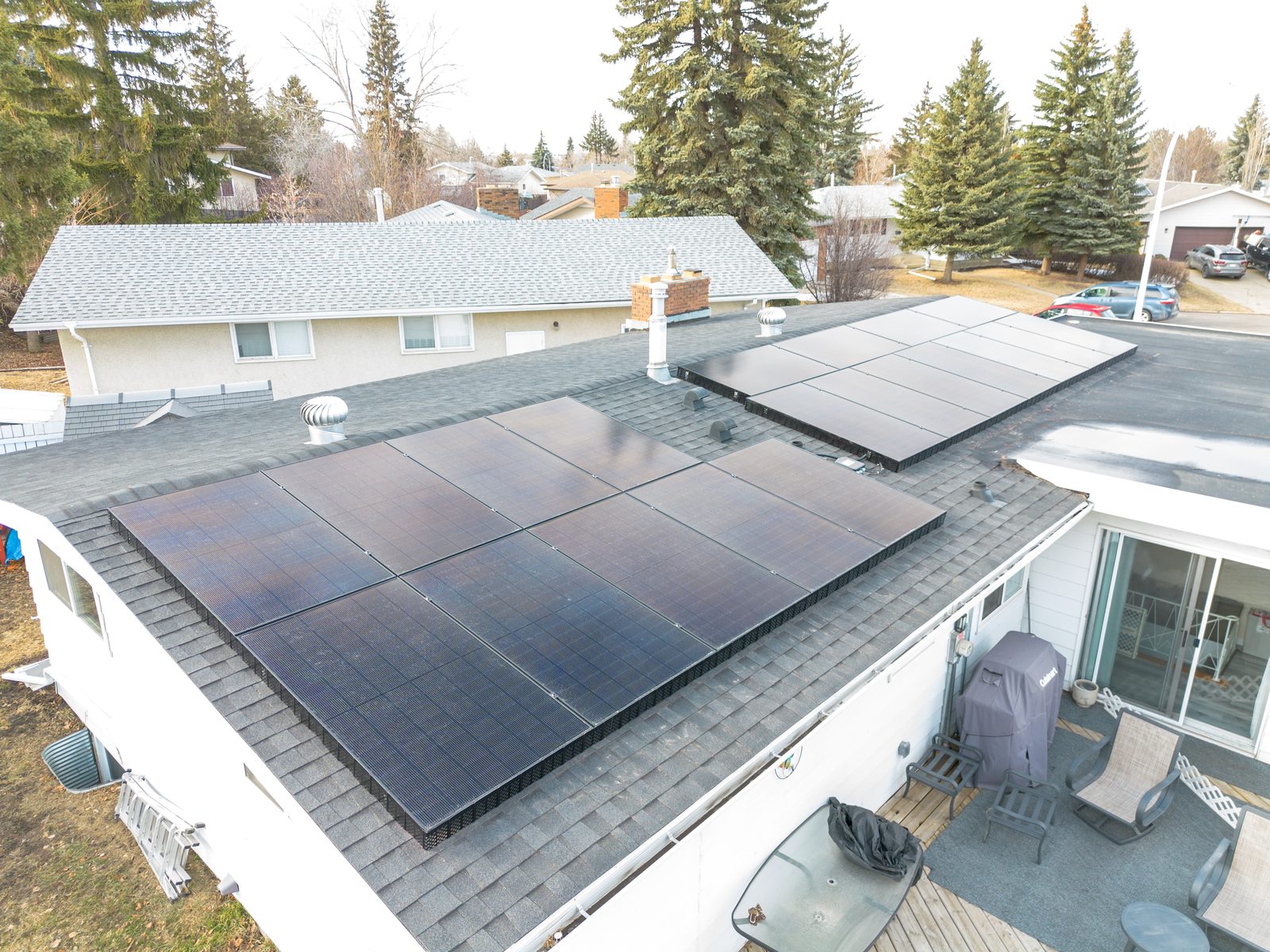
- The short answer
- Yes. tier-1 panels survive a typical Alberta hailstorm. They're IEC 61215 certified (25 mm ice ball at 23 m/s, 11 impact locations). the standard catches the great majority of Alberta hail events. Environment Canada records show most Alberta hail is under 25 mm.
- What they don't catch
- Rare softball-sized hail (75–100+ mm) does damage panels. and a lot of other property at the same time. For those events, what matters is your home insurance. Not the panel rating.
- Alberta hail season
- June through August, with the worst storms typically in July. Edmonton, Red Deer, and the Calgary-to-Edmonton corridor are the most hail-prone parts of Canada.
- Insurance treatment
- Most Alberta home insurance policies cover roof-mounted solar as part of the dwelling structure. Confirm with your carrier in writing before install. Replacement cost vs actual cash value matters.
- Claim documentation
- Pre-install photos of the roof, panel serial numbers on file, monitoring data showing pre-storm and post-storm production, and a roof-level damage inspection by your installer.
- If a storm hits
- Don't go on the roof. Check the monitoring app for production drops. Call your installer for a professional inspection. Notify your insurance carrier as soon as practicable (statutory limitation in Alberta is 2 years; most carriers require "prompt" notice per policy language). Don't accept random door-to-door "roof repair" contractors.
Why this matters in Alberta specifically
Central and southern Alberta sit inside what climatologists call "Hailstorm Alley": the most hail-prone part of Canada and one of the most hail-prone regions in North America. The corridor's documented core runs from High River through Calgary, Red Deer, and Lacombe, with Edmonton on the northern edge and sometimes outside it depending on the storm pattern (Environment Canada definitions vary). Insurance Bureau of Canada data ranks Alberta hail events as the costliest single weather-related insurance category in the country in most years, with the June 13, 2020 Calgary storm driving over $1.2 billion in insured losses on its own (the largest single hail event in Canadian history at the time, since surpassed by the August 5, 2024 Calgary storm that drove an estimated $3.25+ billion in insured losses).
This isn't a reason to skip solar, tier-1 panels handle Alberta hail just fine in normal years, but it is a reason to understand the physics of what panels are tested for, what your insurance covers, and what to do in the rare year when a major storm passes over your roof. Most "do solar panels survive hail" content online is generic North American or Australian; this guide is Alberta-specific.
What hail does solar panels actually survive?
The IEC 61215 standard (what every tier-1 panel is tested for)
The international standard for hail testing on photovoltaic modules is IEC 61215. The test fires 25 mm diameter ice balls at 23 m/s (~83 km/h, ~52 mph) at 11 specified locations on the panel face, including the corners, the edges of the cells, and the center of the laminated glass. The panel must survive without breakage, electrical leakage, or material degradation. Every tier-1 manufacturer (LONGi, Canadian Solar, Q CELLS, REC, Silfab, Jinko, Trina) certifies their residential panels to this standard.
25 mm hail is roughly grape-sized to walnut-sized. Per Environment Canada hail-size records and CatIQ event data, most reported Alberta hail events fall within this envelope. The typical Edmonton or Red Deer hailstorm produces hail in the 10–30 mm range; the rougher central Alberta storms occasionally reach 30–50 mm. All of these are within or close to the IEC 61215 envelope. Panels routinely survive these storms with no measurable production loss.
What about panels rated above the IEC 61215 standard?
Some manufacturers test to higher hail thresholds for marketing purposes. Common premium ratings include:
- 35 mm ice ball at 27 m/s: tested by some premium platforms; survives ~98% of Alberta events
- 45 mm ice ball at 30+ m/s: tested by some commercial-grade panels; survives nearly all "typical bad" Alberta hailstorms but still doesn't cover softball-sized hail
- "HailShield" or proprietary ratings: some manufacturers (notably some Q CELLS and REC products) advertise enhanced hail-resistance with thicker tempered glass and lamination upgrades
The honest assessment: upgrading to a premium hail rating costs roughly 5–15% more per panel and protects you against an additional 2–3% of Alberta hail events. The math usually favours the standard IEC 61215 panel plus a properly structured insurance policy. The exception is high-value commercial installs or rooftops in particularly hail-prone areas (south-central Alberta along Highway 2 between Calgary and Red Deer); for those, premium hail ratings can be worth considering.
What hail breaks panels?
Three failure modes are documented from Alberta hail events:
- Tempered glass shatter from large hail (50 mm+) striking near the panel center or at an obtuse angle. The panel may continue to produce at reduced output for weeks or months, but moisture ingress eventually shorts cells. Requires panel replacement.
- Cell microfractures from medium hail (30–50 mm) that don't visibly damage the glass but crack individual cells underneath. These produce a measurable but not catastrophic production drop (10–25%) and require electroluminescence (EL) testing to confirm. Insurance often covers replacement if monitoring data documents the production drop.
- Junction box / frame damage from glancing impacts. Rare. Cosmetic in most cases, but compromises the IP rating on the back of the panel and should be inspected.
What rarely fails: the mounting hardware. Roof Tech RT-MINI II mounts are ICC-ESR-3575 certified with allowable wind and snow loads specified per attachment spacing in the ESR evaluation report, the load envelope covers typical Alberta wind and snow conditions and translates to direct impact resistance well above what hail delivers. The roof underneath the panel is also typically better protected than the surrounding shingles, solar acts as a shield for the section of roof it covers. The full breakdown of how panels attach, the snow-load math, and the roof-age decision is in Will Solar Panels Damage My Roof? The Honest Alberta Answer.
What insurance carriers cover (and what they don't)
Most Alberta home insurance policies cover roof-mounted solar as part of the dwelling structure. But coverage details vary materially by carrier and policy tier. Here's what we see from working with hundreds of Alberta homeowners across major insurers.
| Carrier | Solar coverage default | Typical conditions |
|---|---|---|
| TD Insurance | Covered as dwelling extension on most home policies | May require notification at install. Replacement cost coverage available; actual cash value on basic tier. |
| Intact (BrokerLink, BCAA, etc.) | Covered as dwelling extension | Coverage typically aligns with primary dwelling structure. Confirm if your panel value exceeds standard endorsement limits. |
| Aviva | Covered as dwelling extension | Many policies require notification of system value over $25,000. Some basic policies require an endorsement. |
| Co-operators | Covered as dwelling extension | Solar-specific endorsements available with broader coverage including production loss in some tiers. |
| Wawanesa | Covered as dwelling extension | Most home policies include. Replacement cost vs actual cash value tier-dependent. |
| Square One (Alberta) | Covered as dwelling extension | Online quote system can flag solar systems for an endorsement; confirm during quote. |
| Direct-write insurers (Belair, Sonnet, etc.) | Variable | Confirm in writing before install. Some don't underwrite solar. |
This table is general orientation; specific policies vary substantially. Always confirm your specific carrier and policy in writing.
Replacement cost vs actual cash value (the critical distinction)
If your panel is destroyed by hail in year 12 of a 30-year lifespan, your insurance can pay out two very different amounts:
- Replacement cost coverage: pays for a comparable new panel installed at current (year-12) market pricing. This is what you want.
- Actual cash value (ACV) coverage: pays the panel's depreciated value, original cost minus 12 years of straight-line depreciation. Typically about 50–60% of replacement cost for a 12-year-old panel.
The difference between RC and ACV coverage on a 10 kW system can be $5,000–$15,000 on a hail claim. Most Alberta home insurance policies default to ACV for "personal property" but RC for "dwelling structure." Solar is generally classed as dwelling structure, confirm this with your specific carrier in writing.
Notification requirements
Most carriers require you to notify them when you install solar. Failure to do so can void coverage on a hail claim. Add the install to your policy at the same time you sign the install contract; provide the carrier with the system value, equipment specs, and the installer's name. Some carriers may adjust premium slightly to reflect the additional property value; the increase is typically modest ($25–$100/year).
Documentation: what to keep on file
Before, during, and after install, build the documentation file your insurance carrier will ask for if you ever file a claim. Stellar provides most of this automatically; if your installer doesn't, ask for it.
- Pre-install roof photos: full roof exterior, all angles, ideally with timestamps. Establishes the roof's pre-install condition.
- Equipment serial numbers: panel-by-panel serial numbers, microinverter serial numbers, racking SKUs. Stellar files these in our project records and provides them to the customer on completion.
- Post-install commissioning report: documents the system in its as-built state, including monitoring app activation. The commissioning report establishes "panel was producing X kWh on day one."
- Monitoring data export: download your monitoring app data quarterly (or set up automated email reports). The app (Enphase Enlighten, SolarEdge mySolarEdge, APsystems EMA, etc.) tracks daily production per panel; this becomes the evidence base if you need to prove a post-hail production drop.
- Insurance policy declaration: the page that lists the solar system as covered. Keep a PDF.
- Original install contract and invoice: establishes the system value for replacement cost calculation.
Store these in one folder (cloud or local). If a hailstorm hits and you need to file a claim, you'll save yourself days of scrambling.
What to do after a major hailstorm
If you're in Alberta and a major hailstorm passes over your home, work through this checklist in order. Do not skip step 1.
1. Stay off the roof
Wet hail-covered shingles are extraordinarily slippery, and post-hail roofs often have hidden damage that's invisible from the ground. Falls from residential roofs cause more injury than hail does. Stay on the ground. If you need to assess damage, use binoculars or a drone. Not a ladder.
2. Document from the ground
Walk the perimeter of your home. Photograph any visible damage to siding, gutters, fences, vehicles, and the visible portion of the roof. Note the hail size if any of it accumulated on the ground (a coin or fingertip for scale). Time-stamp the photos by leaving the timestamp on. This is your initial evidence base.
3. Check your monitoring app
Open the monitoring app for your solar system (Enphase, SolarEdge, APsystems EMA, etc.) and look at production in the 24 hours after the storm. Compare to the same day a week before and the same day a week after. If production drops by 5% or more, that's a strong signal of panel damage even if the panels look fine from the ground. Microinverter-based systems (Stellar uses APsystems DS3) will show per-panel production data, specific panels that drop while others stay normal are a clear damage signal.
4. Call your installer for a professional inspection
Don't accept random door-to-door "roof inspectors" or "we'll fix your hail damage" contractors that fan out across Alberta after major storms. Many of them are storm chasers without electrician licenses; they're not qualified to assess solar panel damage and will sometimes damage your roof further to manufacture an insurance claim. Call your original installer (or another reputable Alberta solar contractor). Stellar offers post-storm inspection to all our customers at no charge.
A professional inspection includes a roof-level visual inspection of every panel, junction box, and racking attachment; an electrical test of the system's output under sunlight; and where damage is suspected but not visible, electroluminescence (EL) imaging to identify cell-level microfractures. The inspection report becomes part of your insurance claim package.
5. File the insurance claim promptly
Most Alberta home insurance policies require notification "promptly" or "as soon as practicable" rather than a specific number of days, but the practical expectation across most carriers is notification within days to weeks. The statutory limitation period for filing a claim in Alberta is 2 years from the date of the loss event under the Alberta Insurance Act. Check your specific policy wording for the contractual notice clause. Call your insurance carrier or broker, provide the post-storm photos, monitoring data export, and the installer's inspection report. The carrier will assign an adjuster.
6. Manage the adjustment process
Adjusters working hail claims have wide variance in experience with solar specifically. Some are excellent and will work directly with your installer to spec a replacement; others have limited solar exposure and may underestimate damage or specify generic "comparable panel" replacements that don't match your original system's microinverter pairing or warranty profile. Have your installer present for the on-site adjustment, or at minimum confirm any replacement spec with them before signing acceptance. The cost of an installer's hour to attend the adjustment is trivial compared to the cost of accepting a wrong replacement spec.
7. Don't sign anything that releases the carrier prematurely
Solar damage sometimes manifests months after a storm (cell microfractures that progress over time as moisture seeps in). Don't sign a "satisfaction of claim" form until your installer has confirmed the system is fully restored and producing normally. Carriers prefer to close claims; you have a legitimate interest in keeping the claim open until performance is verified.
Are some panels measurably better in hail than others?
Within the tier-1 residential panel market, the differences in hail performance are real but modest. Three things drive panel hail resilience:
- Glass thickness. Most residential panels use 3.2 mm tempered glass on the front. Premium platforms (some Q CELLS and REC products) use 4.0 mm or dual-glass laminated construction (LONGi Hi-MO 7 is a dual-glass laminated bifacial design with an IP68-rated junction box). Thicker glass and dual-glass construction survive larger hail.
- Cell layout. Half-cell or third-cell layouts (the standard on most 2025–2026 platforms) distribute stress better than full-cell legacy designs.
- Frame rigidity. Heavier-frame panels flex less under impact, reducing cell-level micro-cracks.
For Alberta specifically, our standard recommendation: LONGi Hi-MO 7 (dual-glass laminated N-type bifacial, IP68-rated junction box, half-cell module layout) performs at or above the IEC 61215 standard and is the panel Stellar standardizes on. Premium hail ratings can make sense in two specific situations: (1) commercial installs in south-central Alberta where the hail risk is highest, or (2) homeowners whose insurance policy doesn't include full replacement cost coverage and who want to reduce the probability of any claim event. For most Edmonton-area residential, the standard IEC 61215 + good insurance is the right structure.
How to set up your install for hail-resilience from day one
If you're installing solar now or in the next year, here's the checklist that minimizes hail-related risk over the system's lifetime:
- Verify the panel's IEC 61215 certification on the datasheet for the specific SKU on your quote. All tier-1 panels meet this; some lower-tier brands skip it.
- Ask for replacement cost coverage explicitly on your home insurance policy. Some carriers default to actual cash value on add-on property.
- Notify your insurance carrier before install and get written confirmation that solar is covered as dwelling structure (or via endorsement).
- Save pre-install roof photos: full coverage, all angles, time-stamped. Your installer should provide these; ask if they don't.
- Confirm equipment serial numbers are on file with your installer and accessible to you (PDF copy is fine).
- Activate the monitoring app and check it monthly: even a casual check builds the production baseline that becomes your evidence base.
- Consider microinverter-based monitoring for per-panel visibility. Stellar's standard APsystems DS3 setup shows daily production for every individual panel, which makes post-storm damage detection straightforward. With string inverters, you only see system-level output, which can mask damage to individual panels.
- Replace aging roofs first. If your asphalt shingle roof is over 15 years old and you're worried about hail, replace the roof first, then install solar on the new roof. A hailstorm that destroys your roof shingles will also force the solar off (and back on after roof replacement), expensive.
Frequently asked questions
Do solar panels protect the roof underneath them?
Yes, the section of roof under solar panels is largely shielded from direct hail impact. The panels themselves take the hit. In areas where the panels cover the roof, the underlying shingles often remain pristine for the panel's 25–30 year lifespan while the surrounding exposed shingles age normally.
What size hail breaks solar panels?
The IEC 61215 standard certifies panels to 25 mm at 23 m/s. Above ~40–50 mm at high velocity, glass breakage becomes plausible. Above 75 mm (softball-sized hail), most residential panels will sustain damage, but so will most vehicles, roofs, and outdoor property; the question becomes an insurance claim. Not a solar-specific question.
Will my home insurance cover hail damage to my solar panels?
Most Alberta home insurance policies cover roof-mounted solar as part of the dwelling structure, but coverage details vary by carrier. Confirm in writing before install. Replacement cost coverage (vs actual cash value) is the more valuable option for solar specifically. Notify your carrier at install.
Does my insurance premium go up if I install solar?
Typically by a modest amount, $25–$100/year for a 7–10 kW system, reflecting the additional property value to be insured. The premium increase is small relative to the system value and to the annual electricity savings.
What happens if I don't tell my insurance carrier about my solar install?
Coverage may be voided on any claim related to the solar system. Most policies require notification of material changes to the dwelling, and a roof-mounted solar system is a material change. Always notify; the cost is minimal and the protection is significant.
Should I pay more for "hail-resistant" premium panels in Alberta?
For commercial installs in south-central Alberta or homeowners with limited insurance coverage, yes. For most Edmonton-area residential with good insurance, the math favours standard IEC 61215 panels (which all tier-1 brands meet) plus a properly structured replacement-cost insurance policy.
What's electroluminescence testing and when do I need it?
EL testing is a specialized inspection that uses an electrical current applied to the panel to make any micro-cracks visible to an infrared camera. It's used when a hail event is suspected to have damaged cells without visibly breaking the glass, the panels look fine, but production has dropped. Insurance adjusters sometimes request EL testing to confirm or rule out hidden damage. Stellar can coordinate EL testing as part of a post-storm inspection if needed.
If my panel is damaged in year 18 of a 30-year warranty, do I get a brand-new replacement?
Depends on the warranty terms and your insurance. The panel manufacturer's product warranty covers defects (not hail damage). Hail damage is an insurance event. If your policy is replacement cost coverage and your installer can spec a comparable current-market panel, you get a new replacement. If your policy is actual cash value, you get the depreciated value of the original panel.
Are bifacial panels more or less hail-resistant than monofacial?
Comparable. Bifacial panels use the same tempered glass on the front; some bifacial designs use glass on the back too (dual-glass laminated), which adds rigidity. LONGi Hi-MO 7 is a dual-glass bifacial design that performs at the top of the standard IEC 61215 envelope.
What's the largest hail event Alberta solar panels have survived?
Anecdotally, Stellar's installed base has come through several Alberta hailstorms in the 30–50 mm range without panel damage. The August 5, 2024 Calgary hailstorm (subsequently estimated at $3.25+ billion in insured losses) produced hail in the 35–70 mm range across central Alberta; production drops on Stellar-installed systems in the affected corridor were negligible. Major historical events like the June 13, 2020 Calgary storm (hail up to 70–75 mm) did cause documented solar panel damage on some installs across the city, for those, insurance claims and panel replacement followed.
Does the solar system make hail damage to my house worse?
No, generally the opposite. The solar panels absorb impact that would otherwise hit the shingles, and the panel-covered section of roof typically suffers less damage in a major event than the exposed section.
Bottom line
Alberta hail is a real factor in solar economics, but it's well-understood, well-tested, and well-insured. Tier-1 panels survive the great majority of Alberta hail events. The rare softball-sized storms are insurance events. Not panel-failure events, the right protection is a properly structured replacement-cost home insurance policy. Not a premium panel upgrade. The combination of IEC 61215 certified panels (Stellar installs the LONGi Hi-MO 7 standard), monitoring-app baseline data, on-file equipment serial numbers, replacement-cost insurance coverage, and a known reliable installer is what keeps your 25-year investment intact through Alberta's worst weather.
Stellar's standard install setup (LONGi Hi-MO 7 with HPDC dual-glass construction, APsystems DS3 microinverters with per-panel monitoring, Roof Tech RT-MINI II self-flashing mounts, pre-install photo documentation, and serial-number records on file) is designed for Alberta-specific risk. We also offer post-storm inspection at no charge to our existing customers and to anyone whose original installer is no longer in business.
Want a hail-resilient solar install or a post-storm inspection on an existing system? Book a free assessment or call (780) 200-5265.
Sources. IEC 61215 photovoltaic module qualification standard (US DOE FEMP, PVEL hail stress white paper, WINAICO technical literature); IEC 61730 PV safety standard; Insurance Bureau of Canada Alberta hail loss data; Catastrophe Indices and Quantification Inc. (CatIQ) Alberta hail event reports; CMOS Bulletin "The Billion Dollar Calgary Hailstorm of 13 June 2020"; CBC News and Wikipedia coverage of the August 5, 2024 Calgary hailstorm; LONGi Hi-MO 7 product literature (dual-glass laminated, IP68 junction box); Roof Tech RT-MINI II ICC-ESR-3575 evaluation report; Environment Canada hail size records; Alberta Insurance Act and Alberta Treasury Board limitations on insurance claims (2-year statutory period); carrier-specific policy documentation (TD Insurance, Intact, Aviva, Co-operators, Wawanesa, Square One); Stellar Upgrades post-storm inspection records from Alberta hail events 2019–2025.