TL;DR. Alberta's grid has already blinked: a province-wide emergency alert on January 13, 2024, and real rotating outages on April 5, 2024 (~244 MW shed) — with the last coal unit now offline. A home battery rides through all of it automatically: under 20 ms switchover, ~36 h of critical-loads backup at 15 kWh, ~48 h at 20 kWh, ~96 h at the 40 kWh Alberta maximum, installed in your attached garage. In Alberta a battery is resilience, not rate arbitrage — there are no residential time-of-use rates to game.
At 6:44 on the evening of Saturday, January 13, 2024, every cellphone in Alberta went off at once. Not a weather warning. Not an Amber Alert. An emergency alert about electricity, telling the entire province that the power grid was at high risk of rotating outages that night and asking people to cut their usage immediately. It was the first time that alarm had ever been used over the electricity supply, and it landed in the middle of one of the coldest nights of the decade.
I had customers text me that night asking the same thing, just worded a dozen different ways: if the power actually goes out right now, at minus forty, what happens to my house?
This post is the long answer to that question. What a grid alert actually is, why Alberta keeps having them, and what changes when your home has a battery, written from the perspective of a company that installs these systems across Edmonton and area every week. I'll keep the marketing to a minimum and the numbers honest, including the parts that don't flatter batteries.
Get a free home battery backup assessment →
What actually happened on January 13, 2024
Here's the timeline, from the public record. A brutal cold snap had settled over all of western Canada, which does two things to the grid at once: it drives heating demand to record levels, and it shrinks the surplus power Alberta can normally import from neighbouring provinces, because they're cold and short too.
The Alberta Electric System Operator (AESO), the agency that runs the provincial grid, declared a grid alert at 3:30 p.m. As the evening peak approached, the AESO projected the province would come up roughly 100 to 200 megawatts short during peak hours, enough of a gap that rotating outages, deliberately cutting power to blocks of homes for about 30 minutes at a time, were on the table.
At 6:44 p.m. the province escalated to an Alberta Emergency Alert on every phone. The wording was blunt: "Extreme cold resulting in high power demand has placed the Alberta grid at a high risk of rotating power outages this evening." It asked people to turn off unnecessary lights and appliances, hold off on major appliances, delay charging electric vehicles and plugging in block heaters, minimize space heaters, and even cook with the microwave instead of the stove.
And it worked. Albertans dropped demand so fast that the AESO recorded roughly a 100 MW drop almost immediately, the grid alert was lifted at 8:40 p.m., and the rotating outages never happened. It was, genuinely, a good-news story about people pulling together. It was also a flare lit over a real structural problem, and that problem hasn't gone away.
Worried about the next one?
We'll tell you exactly what it takes to keep your furnace, fridge and internet running through an Alberta outage, no pressure, no generic package.
This wasn't a fluke: Alberta's grid is structurally tighter now
It would be easy to file January 13 under "freak cold snap" and move on. Two facts make that hard.
The first is that it wasn't one alert, it was four grid alerts between January 12 and 15, 2024, clustered in a single cold stretch. The second is what happened a few months later. On April 5, 2024, the AESO ran out of room and directed real rotating outages, shedding about 244 MW of firm load across the province between 8:53 and 9:16 a.m. That morning a combination of lower-than-forecast wind generation and a gas unit tripping offline opened a gap the grid couldn't cover, and the lights actually went out in blocks. So in the span of one year, Alberta went from "please conserve or we might cut power" to "we are cutting power now."
Underneath all of this, the supply mix is changing fast. Alberta burned its last lump of coal for electricity in June 2024, when the Genesee 2 unit went offline, completing a coal phase-out decades ahead of the original schedule. Coal supplied around 80% of Alberta's power at its peak in the early 2000s; today it's gone, replaced largely by natural gas and a rapidly growing fleet of wind and solar. That's a cleaner grid, and one I'm glad to see, but it's also a grid that behaves differently. Wind and solar are weather-dependent, and the coldest, stillest winter nights, exactly when demand spikes, are often when wind output is lowest. The AESO has been candid that supply margins will stay tight as the system transitions and demand keeps climbing.
Put plainly: grid alerts have gone from a rare curiosity to a normal feature of an Alberta winter. You don't have to believe the grid is going to collapse to take that seriously. You just have to notice that the warnings are getting more frequent, and decide whether you want your household to be a passenger or to have its own backup plan.
What a grid alert asks of you, and why a battery changes your answer
Read that January alert again and notice what it's really asking: stop using your own appliances. Don't cook on the stove. Don't charge your car. Don't run the dryer. For a couple of hours on the coldest night of the year, the province needed hundreds of thousands of households to voluntarily go without.
That's the moment a battery quietly changes everything. If your home has a charged battery, you don't have to choose between helping the grid and living your evening. Your house simply runs on stored power instead of pulling from the strained grid. You cook dinner. The kids keep the lights on. And from the grid's point of view, your home just stopped importing at the worst possible minute, which is precisely the behaviour the AESO was begging for. One house doing that is a rounding error; but it's worth understanding that a battery makes you part of the solution rather than part of the load.
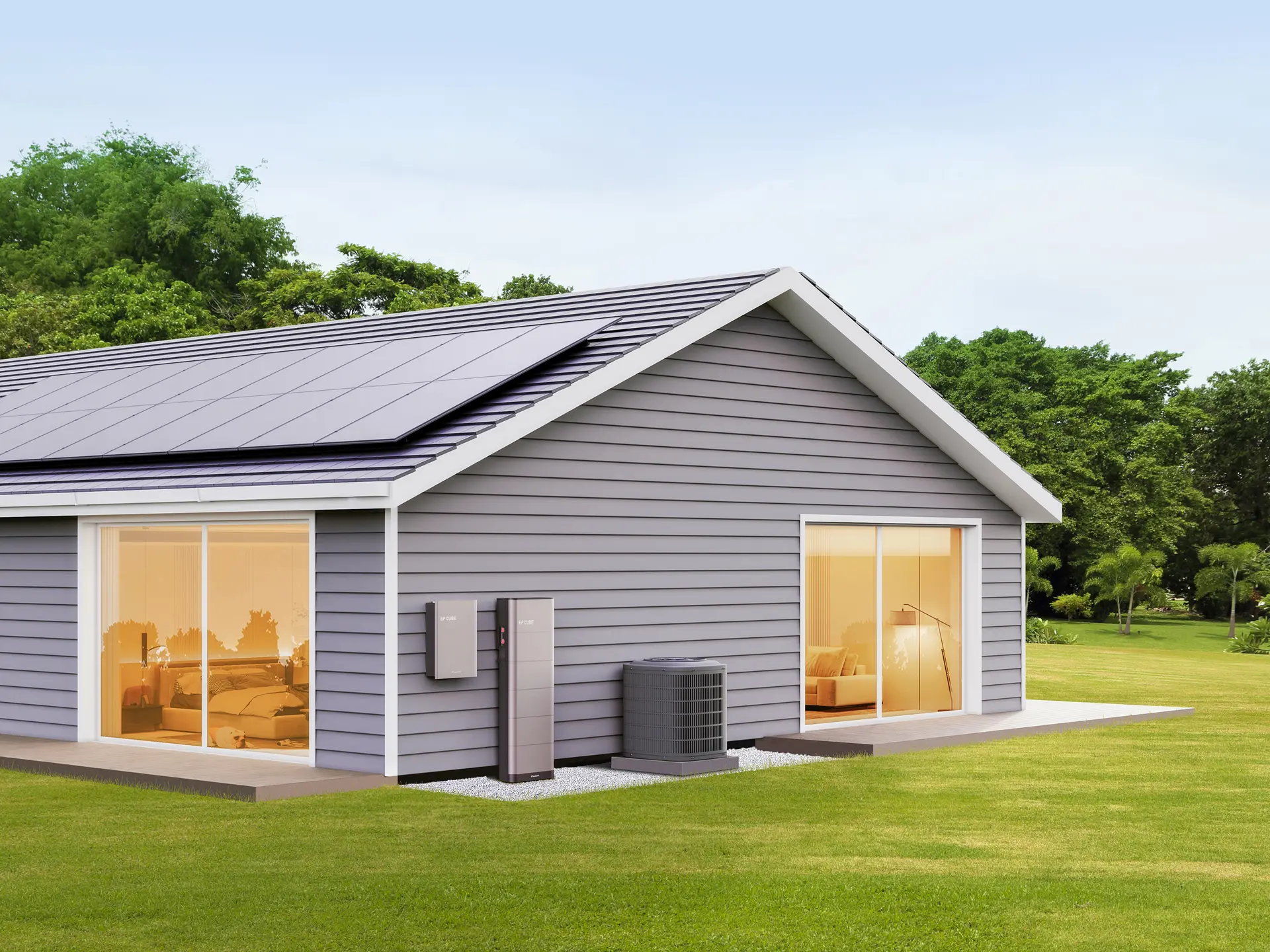
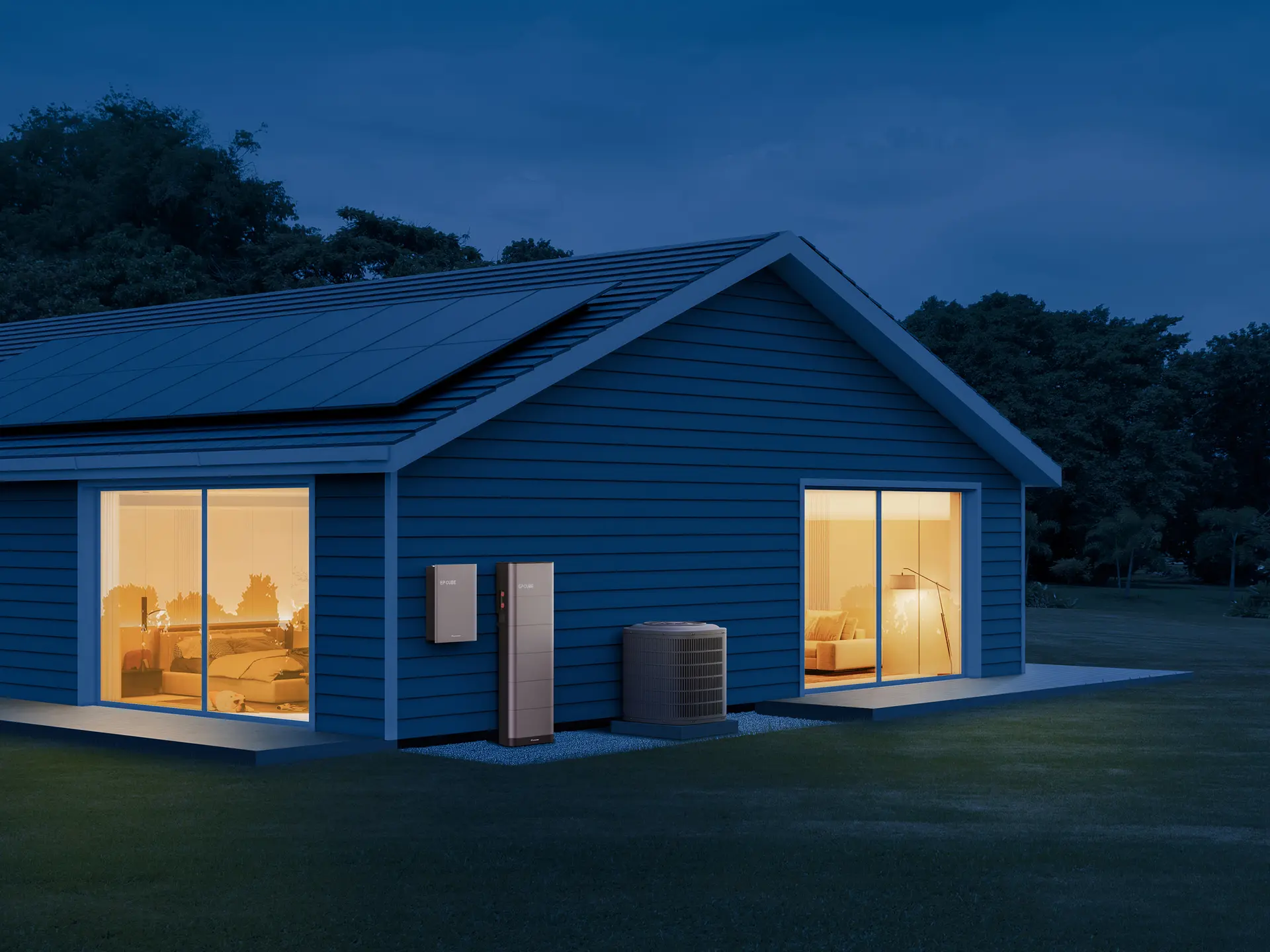
It's worth being precise about two different scenarios, because they get muddled constantly:
- A grid alert is a conservation request. The power is still on. A battery here is about convenience and not adding to the strain, you carry on normally while drawing nothing from the grid.
- An actual outage (a rotating outage, or the far more common storm- or equipment-caused blackout) is when the power is physically gone. A battery here is about safety, your furnace, fridge, sump pump, internet, and medical devices keep running.
And the everyday kind happens more often than people remember. The very afternoon I'm publishing this, June 3, 2026, a swath of southeast Edmonton, the Laurel neighbourhood among them, sat without power for about five hours, from roughly 1 p.m. to 6 p.m. No cold snap, no provincial emergency alert, just an ordinary local outage on a summer afternoon. For a home with a battery, those are five hours nobody inside would have particularly noticed.
A home battery is the rare upgrade that covers both. And in Alberta, the winter version is the one that should keep you up at night, because a winter outage isn't a comfort problem, it's a frozen-pipes-and-no-heat problem.
What a battery does the instant the grid drops
When the grid fails, a properly installed battery system detects it and disconnects your home from the grid (an automatic process called "islanding," which also protects line crews working on the wires outside). Then it starts powering your home from stored energy. On the EP Cube system we install, that switchover happens in under 20 milliseconds, faster than a blink, so fast that your lights don't even flicker and your Wi-Fi router never reboots.
Compare that to a portable generator: you notice the outage, find a flashlight, drag the generator outside, fuel it, pull-start it in the cold, and run extension cords, all while the house has already gone dark and started cooling. The battery has done its whole job before you've found your boots.
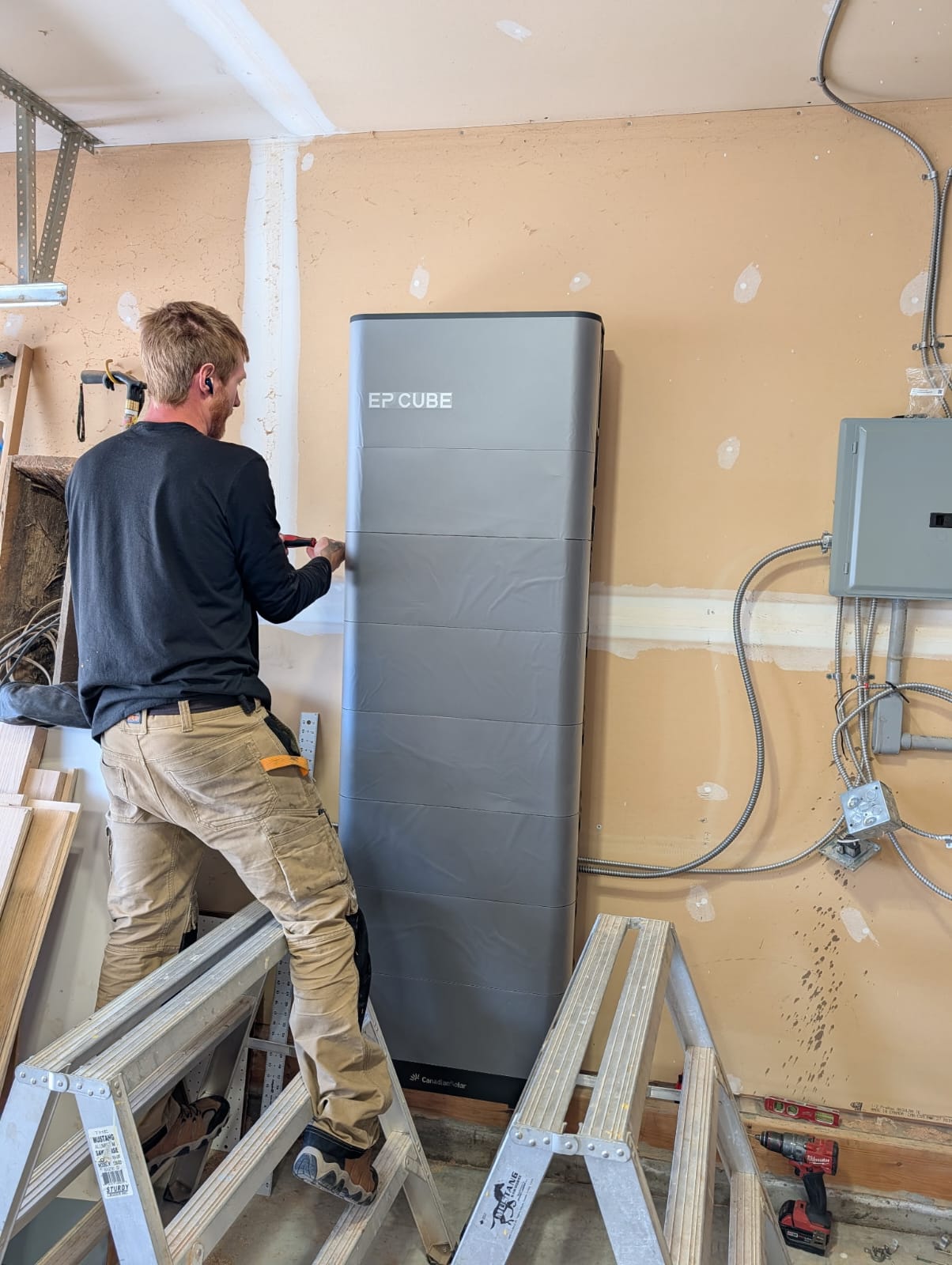
What stays on depends on how the system is configured:
- Critical-loads backup (what we recommend for most homes) runs a pre-selected set of circuits, typically the furnace, fridge, key lights, internet, and sump pump, through a backup subpanel. Smaller battery, lower cost, much longer runtime.
- Whole-home backup runs every circuit in the house. No behaviour change during an outage, but it needs a bigger battery and drains faster if you actually run everything.
For an Alberta winter, the single circuit that matters most is the furnace. A gas furnace doesn't need electricity to make heat, but it absolutely needs it for the blower motor, ignition, and control board, which is why your "gas" heat dies the instant the power does. Backing up that one circuit is the difference between a cold evening and a burst-pipe insurance claim.
How long will it actually last? The honest runtime math
This is where a lot of battery marketing gets slippery, so here's the real arithmetic. A typical Edmonton home's essential winter loads add up to roughly 10 kWh per day:
| Critical load | Approx. daily energy (winter) |
|---|---|
| Furnace blower & controls | ~4 kWh/day |
| Refrigerator | ~3 kWh/day |
| Lighting (LED, partial home) | ~1.5 kWh/day |
| Internet, modem, devices | ~1 kWh/day |
| Sump pump (intermittent) | ~0.5 kWh/day |
| Total essential baseline | ~10 kWh/day |
Run those numbers against the sizes we actually install, and you get backup durations you can plan around:
| Battery size | Critical-loads runtime | What that covers |
|---|---|---|
| EP Cube 2.0 — 15 kWh | ~36 hours | Comfortably rides out most rotating outages and overnight storm outages |
| EP Cube 2.0 — 20 kWh | ~48 hours | A full two days of essentials with no behaviour change |
| Two units — 40 kWh (Alberta max) | ~96 hours | Four days; rural-acreage and frequent-outage territory |
Two things put this in perspective. First, the January 13 grid alert lasted about five hours, start to finish; any battery on this list would have shrugged it off with capacity to spare. Second, and this is the big one: if you have solar, the battery recharges during daylight. In a multi-day outage, a solar-plus-battery home tops up every sunny day and can effectively run indefinitely, with no fuel runs, no jerry cans, no lineups at the gas station during the same storm that knocked the power out. That's the one thing no generator can match. (Yes, Alberta solar produces in winter, we covered the real cold-weather production data in our Alberta winter solar guide.)
If you want to model your own home rather than use these averages, we built a free battery backup duration calculator that lets you punch in your specific loads.
Battery vs. generator for an Alberta cold snap
I'm not going to pretend a battery wins every category, it doesn't. Here's the honest head-to-head for our climate:
| Home battery (EP Cube) | Portable / standby generator | |
|---|---|---|
| Kicks in | Automatically, in <20 ms | Manually (portable) or ~10–30 s (standby) |
| Noise | Silent | Loud |
| Safe indoors / in garage | Yes (no combustion) | No, carbon monoxide; must run well away from the house |
| Fuel needed | None (recharges from solar/grid) | Gasoline, propane, or natural gas |
| Runtime | Finite, unless paired with solar | As long as you have fuel |
| Cold-weather starting | No issue (stored in garage) | Can be hard to start at -30°C |
| Doubles as everyday value | Yes (solar self-consumption) | No, sits idle 360+ days/year |
My honest take: for most Edmonton and area homes, a battery, ideally paired with solar, is the better primary backup, because outages here are usually hours to a day or two, and the battery handles those silently and automatically without anyone touching it. A generator still earns its place on remote acreages where outages can run many days and solar isn't an option. Plenty of rural customers run both. What I'd push back on is the idea that a noisy, fume-producing machine you have to wrestle to life in a blizzard is the only "serious" backup. For the scenarios most families actually face, it's the clumsier tool. We’ve since published the full head-to-head with Alberta installed prices, the 10-year cost table, Edmonton’s permits and noise bylaw, and the -30°C data: Home Battery Backup vs Generator for Alberta Outages.
The cold-weather catch nobody mentions
Here's the caveat that separates an honest installer from a salesperson: the battery itself has to stay warm enough to work. The EP Cube 2.0's published operating range is -10°C to 50°C (its Smart Gateway is separately rated down to -40°C). Edmonton routinely blows past -10°C in January. So a battery bolted to an outside wall, or sitting in an unheated detached shop, is a battery that may throttle or pause in exactly the conditions you bought it for.
The fix is boring and it works: we install in the attached garage. An attached garage shares a wall with your heated home and, thanks to that heat transfer, typically stays above -10°C even when it's -30°C outside, no dedicated heater required. The EP Cube also uses LiFePO4 (lithium iron phosphate) chemistry, which tolerates cold better than older battery chemistries, and its battery management system protects the cells at the extremes. But chemistry isn't a substitute for a sensible location. If your home genuinely has nowhere suitable, a marginal detached garage, no attached garage at all, we'll tell you that before we quote, not after you've signed. Installing a battery somewhere it can't perform is the kind of shortcut that shows up on cheap quotes and nowhere else.
We’ve since published the full winter deep-dive — the spec-sheet split (−10°C cells, −40°C gateway), the LiFePO4 story, and the runtime math in deep cold: Do Home Batteries Work in Alberta Winters?
A basement install is also on the table — it needs its own dedicated battery utility room (18-inch clearance on both sides of the battery, a fire-rated door, a fire alarm, and an exhaust fan), which we build and permit as part of the job. We get into the full code picture, spacing, capacity caps, install locations, in our Edmonton home battery cost and code guide.
So is it worth it, or is it just insurance?
Let me be the one installer who says this plainly: in Alberta, a home battery is not a money-printing machine, and anyone who tells you otherwise is selling you the wrong story.
In some provinces, batteries pay for themselves by charging when power is cheap overnight and discharging at expensive peak times. That math depends on intraday time-of-use rates, and Alberta doesn't have them for residential customers. The Solar Club's seasonal HI/LO rates are real and worth understanding (see our Alberta solar payback breakdown), but they aren't an hour-by-hour arbitrage you can game with a battery. If a quote shows you a battery "paying for itself" on rate arbitrage, the spreadsheet is wrong.
What an Alberta battery actually gives you is two genuine things, plus a third that's hard to price:
- Resilience. Heat, food, sump, and internet that don't care what the grid is doing. In a province trending toward more grid alerts and the occasional real outage, that's worth something concrete.
- Self-consumption (with solar). Instead of exporting your midday solar and buying power back at night, you store your own production and use it after dark, raising the share of your panels you actually consume.
- Not having to care about the next alert. The next time every phone in the province goes off at 6:44 p.m., your plan is to do nothing.
Frame it as insurance with a usage bonus, the way you'd think about a good roof or a sump-pump battery backup, and you'll make a clear-eyed decision. Frame it as an investment with a payback period, and you'll be disappointed for the wrong reasons.
What we install, and what it costs
Our standard offering is the Canadian Solar EP Cube 2.0. In Alberta dwellings the code-eligible sizes are 5, 10, 15, and 20 kWh per unit, with two 20 kWh units (40 kWh total) as the legal maximum per home under Canadian Electrical Code Rule 64-918. The 15 kWh and larger units deliver the full 11.5 kW of continuous backup power, enough headroom to start a furnace blower and sump pump without strain. It's backed by a 10-year manufacturer warranty and Canadian Solar's warranty support out of Guelph, Ontario.
EP Cube 2.0 pricing is consultation-based, because the right size genuinely depends on your home, and I'd rather give you a real fixed number after a 30-minute look than post a figure I'd have to walk back. For full transparency, the previous-generation EP Cube 1.0 and its published pricing ($19,381–$24,723 installed) are now sold out; the EP Cube 2.0 is quoted with one all-in written price at the free assessment, less $1,000 when bundled with a new solar system. The full pricing and code breakdown lives in our Edmonton battery cost guide, and if you're weighing brands, we did a no-spin EP Cube vs Tesla Powerwall 3 comparison too.
We're a local company, master electricians, an in-house crew, 550+ Alberta installs since 2018, and we cover Edmonton, Sherwood Park, St. Albert, Spruce Grove, Stony Plain, Leduc, Beaumont, Fort Saskatchewan, Red Deer, and every community within roughly 200 km of Edmonton.
If you do one thing before next January
You don't need to commit to anything today. But if January 13, 2024 taught Alberta homeowners anything, it's that the time to think about backup is not the evening your phone is screaming at you. A few practical steps:
- Walk your house and list the circuits you'd genuinely need in a 24-hour winter outage. For almost everyone it's furnace, fridge, a few lights, internet, and the sump. That list is your battery size.
- Check whether you have an attached garage or a heated indoor utility space near your main panel, that's where the battery wants to live.
- If you're already considering solar or an EV charger, price the battery alongside them. Shared permits and electrical work make bundled installs meaningfully cheaper than doing them separately.
- Book an assessment and get a real number, so the decision is yours to make on a calm day, not a cold one.
We'll come look at your panel, talk through your critical loads, confirm a code-compliant install location, and give you a fixed installed price the same day, no estimates that change later.
Get a free battery backup assessment → · See full battery pricing →
Sources: Alberta Electric System Operator (AESO), "Albertans Asked to Conserve Power to Minimize Potential for Rotating Outages" and "AESO Thanks Albertans for Quick Response" (January 2024); Alberta Emergency Management Agency, Alberta Emergency Alert, January 13, 2024 (6:44 p.m.); Market Surveillance Administrator, "Alberta electricity system events on January 13 and April 5, 2024"; CBC News, grid-alert coverage and Alberta coal phase-out (Genesee 2, June 2024); Canadian Solar EP Cube 2.0 North American datasheet; Canadian Electrical Code Rule 64-918 / Alberta STANDATA Variance 21-ECV-064-900-ESS; Stellar Upgrades install records (Edmonton and ~200 km radius). Grid figures reflect the public record for the 2024 events; verified June 2026.