- Typical commercial cost
- $1.80–$2.50/W installed for systems 50–500 kW. Bigger systems = lower $/W (scale economies on permits, design, mobilization).
- Federal Clean Tech ITC
- 30% refundable tax credit if the claimant elects to meet federal labour requirements (prevailing wage + apprenticeship); 20% without the election. Available to taxable Canadian corporations on property available for use through Dec 31, 2033. Drops to 15% (or 10%) in 2034. Credit ends after 2034.
- Class 43.2 CCA
- Solar PV equipment qualifies for Class 43.2 (50% declining-balance). The 2024 Fall Economic Statement / Budget 2025 reinstated the Accelerated Investment Incentive, allowing 100% first-year write-off for property available for use through 2029, with phase-out across 2030–2034.
- Demand-charge savings
- Commercial customers pay demand charges on monthly peak kW. Solar production during business-hours peak reduces the demand charge. often the largest single line item in a commercial bill.
- Net metering cap
- Under Alberta Micro-Generation Regulation: 150 kW "small" tier and 150 kW–5 MW "large" tier. Both eligible for credit-rollover net metering.
- Typical payback
- 5–7 years for a properly sized 100–200 kW commercial system after the Clean Tech ITC and Class 43.2 first-year CCA are applied (conservative baseline; faster on larger systems with higher tax brackets and significant demand-charge profiles). 25-year cumulative ROI typically 4–6× cash invested.
- Stellar's commercial capacity
- Up to 200 kW project size standard; larger scope handled case-by-case. Master Electrician of record on every commercial permit.
The 60-second answer
Most Alberta business owners assume commercial solar economics are similar to residential. They aren't. Commercial solar is structurally cheaper per watt to install, qualifies for two layers of federal tax treatment that residential doesn't, and offsets demand charges that homeowners don't pay. Together, those three factors typically deliver simple payback in the 3–5 year range on a properly sized commercial system, less than half the residential payback period, and a 25-year cumulative ROI that routinely exceeds 5× cash invested.
Commercial solar is worth it in Alberta in 2026 if the following are true:
- The building is owner-occupied (or the tenant has a long lease and the right to install), net metering credits flow to whoever pays the meter
- Annual electricity consumption is at least 50,000 kWh/year (smaller commercial loads work but the per-watt economics weaken)
- Load profile is weighted toward daylight hours (offices, warehouses, retail, light manufacturing, not 24/7 cold storage)
- You have roof or ground area for the system (flat membrane roof or south-sloped metal roof is ideal; ground-mount works on adjacent agricultural land)
- You're a taxable Canadian corporation (the 30% Clean Tech ITC requires taxable status, not-for-profits and reserves have different incentive paths)
It does not work as cleanly if you're a tenant without owner consent, you have a 24/7 industrial load profile (the daytime offset is a smaller proportion of total consumption), your roof needs replacement within 5 years, or your tax position can't absorb the CCA write-off (carry-forward applies, but the cash-flow benefit is delayed).
Real installed pricing: by system size
Commercial solar in Alberta is meaningfully cheaper per watt than residential because the fixed costs (engineering, permits, mobilization, site supervision) spread over a much larger system. Wholesale equipment pricing also drops with volume. Typical 2026 installed pricing across reputable Alberta commercial installers:
| System size | Typical roof / site | Installed cost (cash) | $/W cash | Annual production |
|---|---|---|---|---|
| 50 kW | Small warehouse, multi-bay strip retail, large agricultural shop | $120,000 – $135,000 | $2.40–$2.70 | ~60,000 kWh |
| 100 kW | Mid-size warehouse, office building, multi-tenant | $220,000 – $250,000 | $2.20–$2.50 | ~120,000 kWh |
| 150 kW | Large warehouse, two-storey office, farm complex | $315,000 – $360,000 | $2.10–$2.40 | ~180,000 kWh |
| 200 kW (Stellar's standard ceiling) | Large commercial / agricultural ground-mount | $400,000 – $460,000 | $2.00–$2.30 | ~240,000 kWh |
| 500 kW (large commercial) | Multi-tenant industrial, large agricultural | $950,000 – $1,100,000 | $1.90–$2.20 | ~600,000 kWh |
The above are typical straightforward installs: site-specific costs (long conduit runs, panel upgrade requirements, structural reinforcement, complex interconnection) move pricing within and around this range. Ground-mount systems on adjacent agricultural land typically run 5–15% more per watt than rooftop because of racking, trenching, and security fencing requirements.
What's included in a Stellar commercial quote: panel supply (LONGi Hi-MO 7 or commercial-grade equivalent), inverter selection (commercial string or central inverter), all racking, electrical work, structural sign-off, electrical permit, utility Micro-Generation interconnection application (small or large tier per Alta Reg 27/2008), commissioning, Master Electrician of record on the permit, in-house labour (no subcontractors), and the Net Metering paperwork. Project management runs from feasibility study through commissioning under one PM.
The Alberta commercial solar math: worked example
The single best way to understand commercial solar economics is a worked example. Below is a representative 100 kW commercial install on a typical Edmonton-area office building or warehouse. All numbers are conservative.
Inputs
- System size: 100 kW, rooftop, flat-membrane
- Installed cost: $235,000 cash
- Annual production: ~120,000 kWh (Alberta 1,200 kWh/kW/yr)
- Business electricity rate: $0.14/kWh blended energy + delivery (commercial rates run lower per-kWh than residential because of bigger volume; demand charges are billed separately)
- Demand charge: ~$12/kW-month on peak demand
- Pre-solar annual electricity cost: ~$48,000 (energy + demand + admin + transmission)
Annual savings (conservative baseline)
- Energy displaced by solar: 120,000 kWh × $0.14 = $16,800/yr energy savings
- Demand-charge reduction (typical ~30 kW peak shaved): 30 kW × $12 × 12 months = $4,320/yr
- Total baseline annual savings: ~$21,120/yr
Optional upside (not included in baseline): Alberta Emission Offset System credits under the Distributed Renewable Energy Generation protocol can add ~$1,500–$3,500/yr net for a 100 kW system, but only if the system is formally registered through a recognized offset aggregator (Solar Offset, ReWatt Power, etc.) and after aggregator fees of 15–30%. Most small commercial installs are not registered. Treat carbon offsets as optional incremental upside. Not a baseline assumption.
Federal incentives (assuming labour-requirements election: 30% ITC)
- 30% Clean Tech ITC (with labour requirements): $235,000 × 30% = $70,500 refundable credit on the 2026 tax return. If the claimant does NOT elect to meet federal labour requirements (prevailing wage + apprenticeship for on-site work), the rate is 20% = $47,000. The labour election affects ~$23,500 of credit value on a $235K install.
- Class 43.2 CCA + Accelerated Investment Incentive: Under Budget 2025's reinstatement of full first-year CCA for clean-energy generation, 100% first-year write-off of the eligible cost (less the ITC claimed) runs through 2029, then phases out across 2030–2034. For a typical Alberta CCPC at the small-business rate (~12% combined federal-provincial), the first-year CCA on the post-ITC base of $164,500 yields about $19,740 of additional cash-flow benefit. Higher-bracket general-rate corporations (~23% combined) capture roughly $37,800.
Net cash position after year 1 (30% ITC scenario, small-business rate)
- Year 1 system cost: $235,000
- Less Clean Tech ITC refund (30% with labour): −$70,500
- Less Class 43.2 first-year CCA tax savings (12% rate on $164,500): −$19,740
- Less year-1 energy + demand savings: −$21,120
- Net cash out after year 1: ~$123,640
Payback timeline
- Year 2–7 annual savings: ~$21,120 growing at ~4%/yr with Alberta electricity rate escalation
- Simple payback: ~6.2 years from installation on the 30% ITC, conservative-baseline path
- If labour requirements are not elected (20% ITC): payback extends to ~6.8–7 years
- If demand-charge profile is larger (50–60 kW peak shaved on a larger commercial load), payback compresses to 4–5 years
- If registered offset credits are added: payback compresses by ~0.5–1 year
- 25-year cumulative cash flow (4%/yr rate escalation. No carbon credit, 30% ITC): roughly $620,000–$700,000 net of system cost
That ratio, ~$235K invested, ~$620–$700K returned over 25 years on the conservative path, is what most Alberta commercial scenarios produce when you exclude carbon offsets from the baseline. The math is structurally better than residential because of the ITC, CCA, and demand-charge components. Higher-bracket corporations (general 23% combined rate) and larger systems (300 kW+) capture meaningfully more on the same percentage basis.
The three incentives that change commercial economics
1. The federal Clean Tech Investment Tax Credit (30% or 20%)
Introduced in Budget 2023 and in force from March 28, 2023, the Clean Tech ITC is a refundable federal tax credit to taxable Canadian corporations on eligible clean technology equipment, including solar PV, wind, geothermal, electricity storage, and EV charging infrastructure.
The 30% vs 20% choice (critical, this is real money). The credit rate depends on whether the claimant elects to meet federal labour requirements:
- 30% rate: claimant must elect to meet labour requirements, prevailing wage for covered workers on the project site and apprenticeship requirements as defined under the Income Tax Act. Labour requirements apply to work performed on or after November 28, 2023.
- 20% rate: applies if the labour-requirements election is not made.
On a $235,000 install, the labour-requirements election is worth ~$23,500 of additional credit (the difference between 30% and 20% on the eligible cost base). For most owner-operators working with an installer like Stellar (in-house Red Seal Master Electrician and certified electricians on payroll), meeting the labour requirements is achievable, but the election has to be made on the T2 return and the installer must be able to certify compliance for covered workers. Discuss this with your installer and your CPA before signing.
Other key features:
- Refundable: if the credit exceeds your tax liability, CRA refunds the difference in cash, you don't need to be in a tax-paying position to benefit fully.
- Eligible cost basis: the capital cost of eligible property, including installation, electrical work, racking, inverters, and commissioning.
- Time-limited: 30% (with labour) / 20% (without) rates apply for property available for use through December 31, 2033. The credit drops to 15% (with labour) / 10% (without) for property available for use in 2034. The credit ends after December 31, 2034. Earlier installations capture the full rate.
- Available to: taxable Canadian corporations (CCPCs, publicly traded corporations, partnerships with corporate members). Not available to individuals, sole proprietors (for residential installs), or tax-exempt entities, though Indigenous communities and some not-for-profits have alternative parallel programs.
The credit is claimed on the corporate T2 return for the year the equipment becomes available for use. Bookkeeping: the credit reduces the capital cost base for CCA purposes (so you can't double-dip), but the net cash-flow benefit is still substantial.
2. Class 43.2 CCA + Accelerated Investment Incentive (extended to 2029)
Under the Income Tax Act, solar PV equipment qualifies for Class 43.2: a 50% declining-balance Capital Cost Allowance category. Combined with the Accelerated Investment Incentive (AII), eligible Class 43.2 equipment can be fully written off in the first year of ownership.
Important 2025 update: The 2024 Fall Economic Statement and Budget 2025 reinstated the full first-year CCA / immediate-expensing for clean-energy generation equipment (Class 43.1 / 43.2). Under the reinstated rules, the 100% first-year deduction now applies for property available for use 2025 through 2029, with phase-out across 2030–2034 (75% in 2030, 55% in 2031, 35% in 2032, 15% in 2033–2034, then 50% declining-balance from 2035). The earlier (pre-FES-2024) phase-out schedule that would have ended full immediate expensing in 2027 has been replaced.
What this means in practice: a corporation buying $235,000 of solar in 2026 can deduct the eligible amount (less the Clean Tech ITC claimed) as first-year CCA on the 2026 tax return, immediately reducing taxable income at the corporate tax rate. For a typical Alberta small-business CCPC at ~12% combined federal-provincial rate, that's roughly $20,000 of additional first-year cash flow on a post-ITC base of $164,500. For general-rate corporations (~23% combined or higher), the cash-flow benefit is approximately double.
Installing before the end of 2029 captures the full 100% first-year write-off. After 2029, the percentage phases down. After 2034 it reverts to 50% declining-balance, which still yields meaningful tax benefit but spreads it across more years.
3. Demand-charge savings (the part homeowners don't get)
Commercial electricity bills in Alberta have three or four components: energy (¢/kWh consumed), delivery (¢/kWh delivered, set by the wires company), demand ($/kW based on the monthly peak kW reading), and admin / transmission / riders. Demand charges typically run $7–$15 per kW-month on Alberta commercial accounts. For a building pulling 80 kW at peak (a typical 50,000 sq ft warehouse), demand charges alone run $7,000–$14,000/yr.
Solar shaves the peak demand reading when production aligns with business hours, which it does for most commercial loads (offices 8 am to 5 pm, warehouses 6 am to 6 pm, retail 9 am to 9 pm). Properly sized commercial solar can reduce demand-charge billing by 25–40% in addition to the energy displacement. That's an Alberta-specific saving that doesn't appear on a residential bill and is often the most cash-positive single line item on a commercial solar pro forma.
Net metering for commercial (Alberta Micro-Generation Regulation)
Under Alta Reg 27/2008, commercial micro-generators are eligible for net metering on the same crediting basis as residential. Two tiers:
- Small micro-generation: under 150 kW nameplate. Standard micro-generation application; most municipalities have streamlined approval timelines (typically 30–60 days for the utility interconnection agreement).
- Large micro-generation: 150 kW to 5 MW nameplate. Same crediting structure but more complex interconnection studies and longer approval (90–180 days typical), and may require interconnection studies funded by the applicant.
For systems sized to roughly 100% of historical annual consumption, net metering settles credits annually and rolls forward any surplus through the year. Above-consumption sizing is generally not permitted under the Micro-Generation Regulation; for systems sized larger than your consumption, you're in Power Purchase Agreement (PPA) territory with the wires company, which is a different regulatory pathway entirely.
What kind of buildings make sense for commercial solar in Alberta
Best fits
- Single-tenant warehouses with large flat-membrane roofs, high daytime electricity load, and owner-occupied billing. Typical install: 100–500 kW rooftop.
- Owner-occupied office buildings with 8 am to 5 pm load profiles and metal-deck roofs. Typical install: 30–150 kW rooftop.
- Light manufacturing facilities with daytime production schedules. Typical install: 100–500 kW; large electrical loads make ROI very strong.
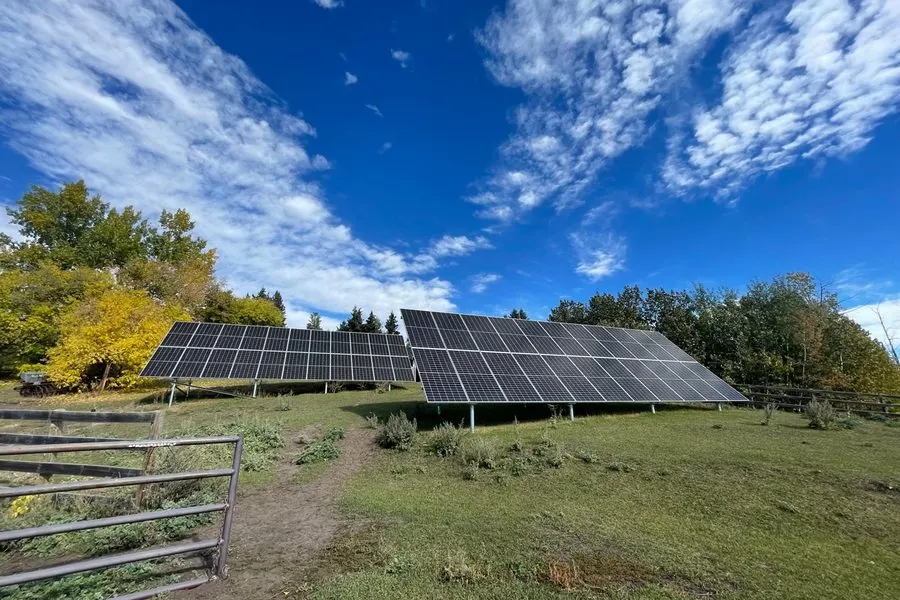
- Agricultural operations with adjacent ground-mount sites, especially dairy, irrigated crops, grain drying. Stellar has multiple ground-mount installs in central Alberta. (Stellar's farm-solar editorial: coming soon.)
- Multi-bay retail / strip plazas where the landlord pays a single master meter. Typical install: 50–150 kW rooftop.
- Self-storage facilities with large flat roofs and modest direct consumption (the system is sized to slightly more than facility load, exporting to the grid for credit).
Harder fits
- 24/7 cold storage: baseload is high and constant, so the daytime offset proportion is smaller, and net metering can't store summer credits across seasons as cleanly.
- Multi-tenant buildings with split-meter billing: harder to allocate solar production across tenants without a virtual net metering framework (Alberta doesn't have one yet).
- Roofs over 20 years old: same as residential, replace the roof first.
- Heritage-listed commercial buildings with restrictions on roof modification.
- Tenants on short leases: payback window exceeds remaining lease length.
The Alberta commercial solar timeline (contract to commissioning)
Commercial solar in Alberta runs on a longer timeline than residential because of larger engineering scope, more complex interconnection studies, and bigger procurement lead times. A realistic Stellar commercial timeline:
| Phase | Typical duration | What's happening |
|---|---|---|
| Feasibility study | Week 1–2 | Roof survey, structural review, shade analysis, electrical service assessment, preliminary system sizing, indicative pricing. |
| Engineering & design | Week 2–6 | Full electrical engineering stamped by P.Eng., structural engineering review for roof load capacity, equipment selection, final system design. |
| Permits & interconnection | Week 4–14 | City building permit + electrical permit + Micro-Generation interconnection application to EPCOR, FortisAlberta, ATCO Electric, or ENMAX. For 150 kW+ systems, an interconnection study may be required (4–12 weeks). |
| Equipment procurement | Week 6–12 | Panel, inverter, racking, and balance-of-system procurement. Typical lead time for commercial inverters: 6–8 weeks. |
| Installation | Week 12–20 | Crew on site. 100 kW: typically 2–3 weeks of physical install on flat-membrane roof. 500 kW: 4–8 weeks. |
| AHJ inspection & commissioning | Week 18–24 | Authority Having Jurisdiction inspects, electrical certificate issued, commissioning tests run, system handed over to operations. |
| Bi-directional meter swap & net metering activation | Week 22–28 | Wires company installs revenue-grade bi-directional meter. Net metering goes live. |
Total elapsed time: 5–7 months for a 100–200 kW commercial install. Larger systems run longer. Note: most of this is parallel-pathed (permits and equipment procurement happen simultaneously while engineering is finalized), not strictly sequential.
How to choose a commercial solar installer in Alberta
The five questions to ask a commercial solar installer (beyond the 11 residential questions in our how to choose a solar installer guide):
- Who is the engineer-of-record (P.Eng.) for electrical and structural design? Commercial solar requires stamped engineering from a P.Eng. Ask for the name and license number, and whether they're in-house or contracted.
- Have you completed commercial systems of this size class before? A residential installer trying to ramp into 200 kW commercial is taking on engineering, permitting, and interconnection complexity they may not be staffed for. Ask for three references at your size class.
- Who handles the utility interconnection application? Including the 150 kW+ interconnection study if applicable. The installer should own this end-to-end. Not hand it back to you.
- What's the warranty structure on commercial systems? Workmanship warranty terms, performance guarantees if any, and what the warranty looks like if the installer goes out of business in year 7.
- Are you a Solar Alberta member and a CEIP-qualified contractor? Solar Alberta is the Alberta industry association; CEIP is the municipal financing program. Both have vetting requirements.
Want a real feasibility study for your specific building? Drop your details and the rough size of your facility. We'll send a no-obligation feasibility memo with rooftop layout, exact installed cost, and ITC + CCA math for your tax position within 48 hours.
No spam. Calculator math: cost scales $/W from $2.55 at 50 kW to $2.05 at 500 kW. Annual energy savings = system kW × 1,200 kWh/kW/yr Alberta production × your rate. Demand savings = ~25% of system kW × demand charge × 12. ITC reduces CCA base. Payback excludes optional carbon offset credits (those require formal Alberta Emission Offset System registration and aggregator fees). Real feasibility study refines all of this against your specific building.
Frequently asked questions
How much does commercial solar cost in Alberta in 2026?
Typical 2026 installed pricing: $1.80–$2.50/W for systems 50–500 kW. Reference points: 50 kW $120,000–$135,000; 100 kW $220,000–$250,000; 150 kW $315,000–$360,000; 200 kW $400,000–$460,000; 500 kW $950,000–$1,100,000. Cash, before the 30% Clean Tech ITC and Class 43.2 CCA are applied.
What's the payback period for commercial solar in Alberta?
Typically 5–7 years on a 100–200 kW system at small-business tax rates after the Clean Tech ITC (30% with labour requirements / 20% without), the 100% first-year Class 43.2 CCA, and demand-charge savings are applied. Faster (4–5 years) on larger systems with bigger demand-charge profiles and higher tax brackets. Specific payback depends on electricity rate, demand-charge structure, daytime load profile, tax position, and whether labour requirements are elected.
What is the federal Clean Tech Investment Tax Credit?
A refundable federal tax credit on eligible clean-technology equipment, including solar PV, batteries, and EV charging infrastructure. The rate is 30% if the claimant elects to meet federal labour requirements (prevailing wage + apprenticeship) or 20% without the election. In force at full rate through Dec 31, 2033, drops to 15% (with labour) / 10% (without) in 2034, ends after 2034. Available to taxable Canadian corporations. The credit reduces the capital cost base used for CCA purposes.
How does Class 43.2 work for solar?
Solar PV equipment qualifies for Class 43.2 (50% declining-balance CCA). Under Budget 2025's reinstated Accelerated Investment Incentive, full 100% first-year write-off applies for property available for use 2025 through 2029, with phase-out across 2030–2034. After 2034 it reverts to 50% declining-balance. For a corporation at the small-business rate (~12% combined federal-provincial), the first-year CCA cash-flow benefit on a $235,000 install is approximately $19,740 above the 30% ITC.
Can solar reduce my demand charges?
Yes, this is often the largest single saving on a commercial solar bill. Demand charges are billed on the monthly peak kW reading. If your peak demand falls during daylight business hours (typical for offices, warehouses, retail, light manufacturing), solar production reduces the peak reading. A properly sized commercial system typically shaves 25–40% of demand-charge billing in addition to energy displacement.
Does net metering work for commercial systems?
Yes. Alberta Micro-Generation Regulation (Alta Reg 27/2008) supports two commercial tiers: small (under 150 kW) and large (150 kW–5 MW). Both tiers receive credit-rollover net metering through your retailer. Systems sized above your historical annual consumption are not eligible, you'd need to pursue a Power Purchase Agreement with the wires company instead, which is a different regulatory path.
How long does commercial solar take to install in Alberta?
Contract to commissioning: typically 5–7 months for a 100–200 kW system. Larger systems (300 kW+) run 7–10 months. Most of the time is engineering, permits, and interconnection studies running in parallel with equipment procurement. Physical install is 2–8 weeks depending on system size.
What's the largest system Stellar will install?
Stellar's standard residential/commercial scope is up to 200 kW per project. Larger commercial scope is handled case-by-case during the free assessment. For systems above 200 kW, we'll discuss whether the project aligns with our crew capacity and engineering depth, or whether we should recommend partner installers better-fit for larger industrial scale.
Do agricultural / farm operations qualify for commercial solar incentives?
Yes. Farm operations structured as corporations qualify for the 30% Clean Tech ITC and Class 43.2 CCA on solar installations. Alberta-specific farm programs (such as On-Farm Solar PV Program, where available) can stack on top. Sole-proprietor farms have a different incentive path (they're treated as individuals for tax purposes); incorporated farms get the full corporate stack. We cover the farm-specific details in a dedicated farm solar guide (coming soon).
Do not-for-profit organizations or First Nations communities qualify?
The 30% Clean Tech ITC is for taxable Canadian corporations and is not available to tax-exempt entities. There are parallel federal programs for Indigenous communities and not-for-profits (Indigenous Off-Diesel Initiative, Greener Communities Initiative, etc.) that fill the same role with different funding mechanisms. The right path depends on the specific organization structure, we walk through this during the free assessment.
What happens if I sell the building before payback?
Solar systems generally increase commercial property value, but the recovery on sale depends on the buyer's tax position and the remaining warranty period. The 30% Clean Tech ITC and Class 43.2 CCA already claimed don't have to be returned if the building is sold (provided the system remains in commercial use). If the system was the bulk of the value-add, prospective buyers will price it into the offer; if you're selling within 2–3 years of install, the math is closer to break-even on the system itself.
Can I use commercial solar with a power purchase agreement (PPA)?
PPAs are uncommon in Alberta commercial solar in 2026 because (a) net metering credits already provide the cash-flow flexibility most projects need, (b) the Clean Tech ITC is most valuable when the building owner owns the equipment directly, and (c) Alberta's electricity market structure doesn't lend itself well to long-term fixed-price PPAs at the small-commercial scale. PPAs exist for utility-scale solar (5 MW+) but not typically for the 50–500 kW commercial range.
Bottom line
Commercial solar in Alberta in 2026 is the strongest financial case in the entire solar market, better than residential, better than most municipal incentive programs, and structurally underpinned by three federal tax mechanisms that are scheduled to phase out by 2034–2035. The Clean Tech ITC (30% with labour requirements, 20% without) + 100% first-year Class 43.2 CCA (now extended through 2029 under Budget 2025) + demand-charge savings combine to deliver 5–7 year payback on a mid-range 100–200 kW system at small-business tax rates, faster on larger systems and higher-bracket corporations. 25-year cumulative ROI typically runs 4–6× cash invested on the conservative path.
If your business owns its building, consumes at least 50,000 kWh/year, and has roof or ground space, commercial solar deserves serious financial modeling. The math has rarely been better and the incentive phase-out means earlier installs capture more value than later ones.
Stellar Upgrades handles commercial projects up to 200 kW under the same in-house crew and Master Electrician of record that runs every residential install, across Edmonton, Sherwood Park, Spruce Grove, Stony Plain, Leduc, Beaumont, Fort Saskatchewan, Red Deer, and every other community within ~200 km of Edmonton in every direction. Free 30-minute feasibility consult to walk through your roof, your bill, your tax position, and the system size that fits. Book a commercial assessment or call (780) 200-5265.
Sources. Income Tax Act, Class 43.2 (Schedule II of the Income Tax Regulations); Department of Finance Canada Budget 2023 Clean Technology Investment Tax Credit; CRA "About the Clean Technology Investment Tax Credit" guide; CRA "Labour Requirements" guide for Clean Economy ITCs; 2024 Fall Economic Statement / Budget 2025 reinstatement of Accelerated Investment Incentive (Class 43.1/43.2 immediate expensing through 2029); Alberta Micro-Generation Regulation (Alta Reg 27/2008, CanLII); AESO Connecting Microgeneration documentation (Sept 2025); Alberta Utilities Commission tariff filings; Natural Resources Canada Class 43.1/43.2 tax savings publication; Alberta Emission Offset System Quantification Protocol for Distributed Renewable Energy Generation (TIER); Stellar Upgrades commercial project records (Edmonton + ~200 km radius). Tax treatment specifics depend on corporate structure and labour-requirements election and should be verified with a CPA familiar with your business before relying on the worked-example numbers. All figures verified May 2026; subject to legislative change.