TL;DR. Most Edmonton homes — including 100A ones — do not need a $1,500–$3,000 panel upgrade for an EV charger. A 48A Level 2 charger is an 11.5 kW continuous load needing a 60A breaker, and the code counts it at 100%… unless you use an EVEMS (load management, CEC Rule 86-300), which is built into the Emporia Pro and included with the Wallbox we install. The genuine upgrade cases are the exceptions — this guide shows you the 5-minute self-check.
You ordered the EV. Somewhere between the deposit and the delivery date, a practical question shows up: where am I going to plug this thing in, and can my house even handle it? Almost everyone starts by researching chargers, 40 amp versus 48 amp, Wallbox versus the rest. That's the wrong first question.
The charger is the easy part. The variable that actually decides whether your install is a clean afternoon's work or a bigger job is your home's electrical panel, specifically, whether your service has enough headroom to feed a charger. Get clear on that one thing and the rest falls into place. Here's how to figure out where your Edmonton home stands, in plain language, with the real Alberta code rules that govern it, and the one provision that quietly saves most older homes from a costly upgrade.
The good news up front: most homes we look at can add a Level 2 charger without a service upgrade. But "most" isn't "all," and knowing which group you're in before the car arrives is worth a few minutes.
Get a free EV-readiness assessment →
The one number that decides almost everything: your service amperage
Every home has an electrical service rated in amps, the total amount of power it can safely draw from the grid at once. In our area you'll almost always have one of two:
- 100A service — common in Edmonton-area homes built before roughly 2000. Plenty for a traditional gas-heated house, but the tighter of the two once you start adding big electric loads.
- 200A service — standard in newer builds. Usually has comfortable room for an EV charger on top of everything else.
You can check yours in thirty seconds: open your electrical panel and read the number stamped on the big main breaker at the very top. It'll say 100, 125, 150, or 200. That number is your ceiling.
Now here's why a charger is a big deal against that ceiling. A Level 2 EV charger is one of the largest single loads in a house. A 48-amp charger delivers 11.5 kW, and because the electrical code treats EV charging as a continuous load, the circuit has to be sized at 125% of that, a 60-amp breaker with appropriately sized copper. A 40-amp charger needs a 50-amp breaker. Put a 60-amp circuit next to a 100-amp service and you can see the problem at a glance: the charger alone wants the equivalent of nearly half your home's entire capacity.
That doesn't mean a 100A home can't have a charger, it absolutely can, as you'll see in a moment. It just means you can't treat an EV charger like plugging in another toaster. The circuit, the breaker, and the whole service all have to support it.
Not sure what's in your panel?
Text us a photo of your main breaker. We'll tell you your service size and whether you're EV-ready, usually same day, no charge.
Why you can't just count the empty breaker slots
A common assumption: "I have two free slots in my panel, so I'm fine." Empty slots are necessary but they're not the same as spare capacity. What matters is whether your service has enough headroom once every load is properly accounted for, and that's governed by a formal calculation, not a glance at the panel.
Under Rule 8-200 of the Canadian Electrical Code (the single-dwelling load calculation), an electrician adds up your home's demand: a base load for the floor area, your electric range, any electric heat or air conditioning, water heater, and so on, each with the demand factors the code allows. The total has to fit inside your service rating, and the minimum service for a typical house works out to 100A.
Here's the catch that trips up EV charging specifically. An EV charger does not get a diversity discount, the code requires it to be counted at 100% of its rating, on the assumption it could run at full power for hours (which, overnight, it does). So when you bolt 11.5 kW onto a load calc for a home that already has an electric range and a couple of other big loads, a 100A service can tip over the limit on paper, even if you've never once come close to that draw in real life.
This is the moment a lot of homeowners get quoted a $1,500–$3,000 panel upgrade. Sometimes that's genuinely necessary. Often it isn't, because the code gives us two well-established ways around it. (The City of Edmonton publishes the residential load-calculation form its inspectors use, and Alberta's STANDATA bulletins set out the demand-factor rules, this isn't a grey area, it's arithmetic.)
The code trick that saves most homes a $4,000 upgrade: EVEMS
This is the part most "do I need to upgrade my panel" articles never mention, and it's the single most useful thing to know.
Section 86 of the Canadian Electrical Code, the section that governs EV charging, recognizes a device called an EVEMS: an Electric Vehicle Energy Management System. Under Rule 86-300, you're normally required to put EV charging on its own dedicated circuit sized for the full load. But the code also permits the charger to share capacity with the rest of the home provided an EVEMS is in place to prevent an overload.
Mechanically, an EVEMS watches your home's real-time electrical draw and automatically throttles or pauses the EV charger whenever the rest of the house ramps up, the oven, the dryer, the A/C all kicking on at dinnertime. The car simply charges a little slower for those minutes, then speeds back up when the demand passes. You never notice, because the car is parked there for ten hours and only needs a few.
The payoff is in the math: because the EVEMS makes an overload physically impossible, the code lets your electrician leave the full EV load out of the service calculation. That's the move that keeps a 100A home off the upgrade path. The thing that "failed" the paper calc, the 11.5 kW counted at 100%, no longer has to be counted that way.
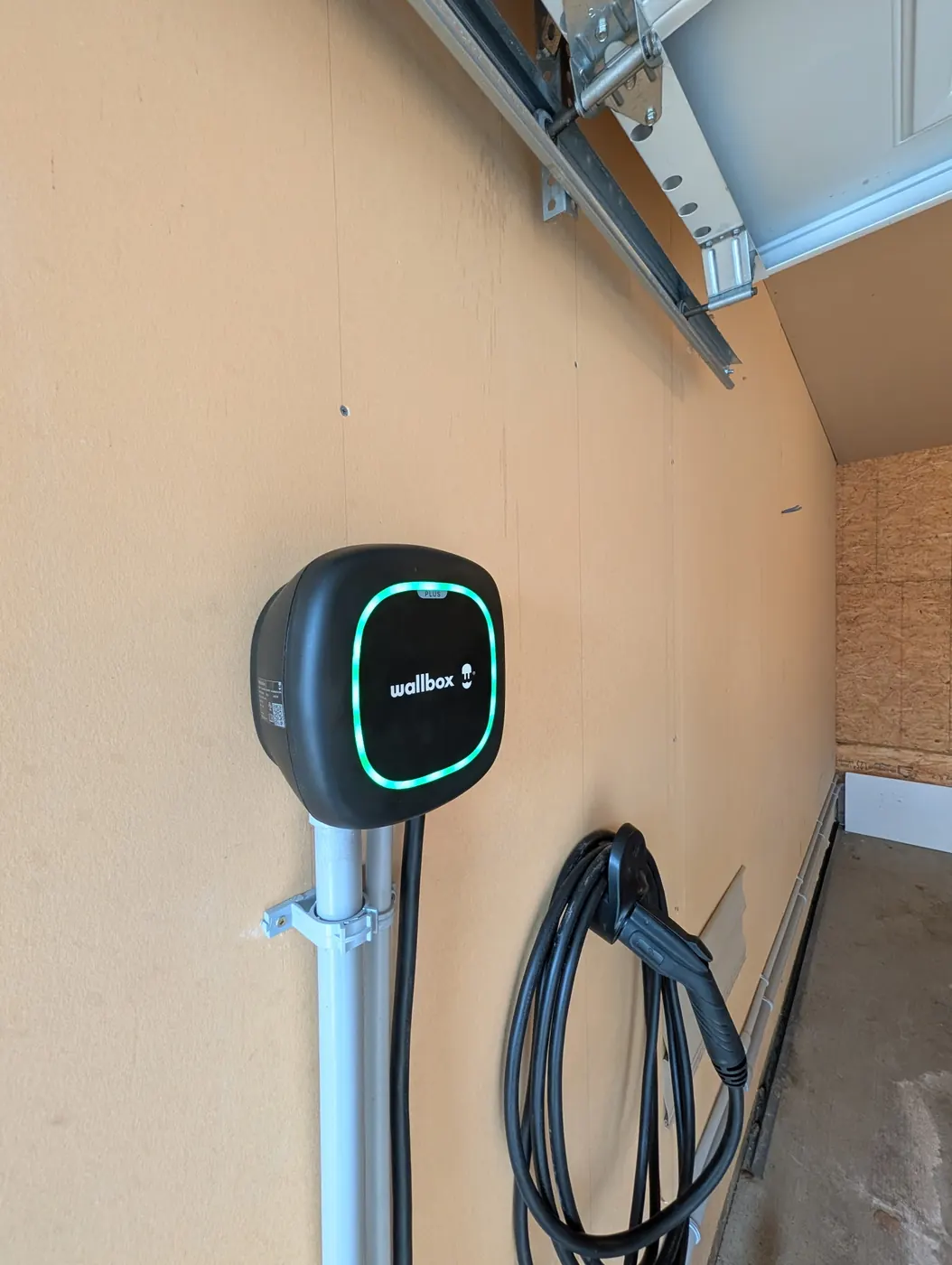
In practice, we deliver this two ways. The Emporia Pro, the charger most of our customers choose, has PowerSmart load management built in, it auto-adjusts the charge rate to your panel's service rating, so there's no add-on to buy at all. On the Wallbox Pulsar Plus, the equivalent is the Wallbox Power Boost, a dynamic load-management device included in our installed price. Either way, for the large majority of older Edmonton homes that would otherwise be quoted a panel upgrade, load management does the same job for a fraction of the price. That's not a sales angle, it's the cheaper answer, and it's usually the right one.
The second upgrade-avoider: your real demand history (Rule 8-106)
There's a second tool, and it's almost as underused. The standard load calculation is deliberately conservative, it assumes big appliances might all run flat-out together. Your home almost never actually behaves that way.
Rule 8-106 of the code permits a "demonstrated load" method: instead of the worst-case assumption, your electrician can request your actual recorded peak demand over the past 12 months from EPCOR (or whichever utility serves you) and add the EV charger's nameplate to that real, measured number. Homes that look maxed-out on the conservative calc frequently pass with room to spare once their true demand is on the table, because the measured peak is so much lower than the theoretical one.
We pull that EPCOR demand data as a normal part of an assessment. Between the demonstrated-load method and an EVEMS, the number of Edmonton homes that genuinely cannot add a Level 2 charger without a service upgrade is small.
When you genuinely do need a 200A upgrade
I'm not going to pretend the upgrade is never the answer. Some homes really have run out of room, and you should be told that honestly rather than sold a workaround that doesn't fit. You're a real candidate for a 100A-to-200A service upgrade if:
- Your home is already heavily electrified, electric furnace or heat pump, electric range, electric water heater, hot tub, and you want to add EV charging on top.
- You're planning a second EV, and want two chargers running at full speed simultaneously.
- You're future-proofing for solar and a home battery, where a 200A service gives you cleaner headroom for the whole electrification stack.
A 100A-to-200A upgrade in the Edmonton area typically runs $1,500–$3,000, depending on your meter base, mast, grounding, and the EPCOR coordination involved. When it's the right call, it's money well spent, it raises your home's ceiling for everything that comes next. We just won't recommend it until we've confirmed an EVEMS won't do the job, whether that's the load management built into the Emporia Pro or the Power Boost included with the Wallbox.
A 5-minute self-check before you call anyone
Want a rough read on where you stand before you talk to an electrician? Walk through this:
- Find your service size. Open the panel, read the main breaker: 100, 125, 150, or 200 amps.
- Count your big 240-volt loads. Electric range, electric dryer, central A/C, electric water heater, hot tub. The more of these you have, the tighter your headroom, especially on 100A.
- Note your home's age. Pre-2000 in our area usually means 100A; newer usually means 200A.
- Measure the run. Roughly how far is your panel from where the charger will go? Up to 10 m of conduit is standard; long runs (panel in the basement, charger in a detached garage) add a bit.
If you're on 200A with a gas range and gas heat, you're almost certainly good to go as-is. If you're on 100A with several electric loads, you're the classic EVEMS candidate, very likely a charger with load management (built into the Emporia Pro, or a Power Boost on the Wallbox) and no upgrade. Either way, the only way to know for certain is the formal calc, which is exactly what the free assessment is for.
Get a straight answer before the car arrives
Free 30-minute EV-readiness assessment: we read your panel, run the load calc, pull your EPCOR demand, and give you a fixed installed price the same day.
What we actually install (and what it costs)
We install two chargers. Most customers choose the Emporia Pro, which has PowerSmart load management, exactly the kind of upgrade-avoider this article is about, built in at no extra cost, plus a Vue 3 whole-home energy monitor so you see your whole home's energy use live in the app. The premium alternative is the Wallbox Pulsar Plus, one of the best-built residential chargers on the market, which includes the Power Boost load-management device in the installed price. Our installed pricing is fixed and published, not estimate-based:
| What you get | Emporia Pro (most popular) | Wallbox Pulsar Plus |
|---|---|---|
| Fully installed price | $3,099 (40A) / $3,599 (48A) | $3,499 (40A) / $3,999 (48A) |
| Charging speed | 40A: up to ~40 km/hour · 48A: up to ~50 km/hour (11.5 kW) | |
| Breaker / circuit | 40A charger: 50A breaker · 48A charger: 60A breaker | |
| Load management | PowerSmart built in — no add-on needed | Wallbox Power Boost — included in installed price |
| Connectors | J1772 or NACS option | J1772 + NACS included |
| EV compatibility | Every EV on the market, including Tesla | |
| Included | Charger, EMT conduit (up to 10 m), electrical permit, inspection · Emporia Pro adds the Vue 3 whole-home energy monitor | |
| If your panel needs help | Load management as above · or 200A upgrade $1,500–$3,000 (only if truly required) | |
Every install is done by our in-house team and permitted under a Red Seal Master Electrician, on the current 2024 Canadian Electrical Code that's been in force across Alberta since April 1, 2025. We pull the permit in our own name as the licensed installer, an unpermitted EV charger is the kind of thing that surfaces at home-sale or insurance-claim time, so it's never optional with us. One honest note for 2026: there are currently no residential EV charger rebates in Alberta; federal and provincial programs cover vehicles or commercial/multi-unit chargers only. If a quote dangles a home-charger rebate, ask hard questions.
For the full pricing teardown (why Edmonton quotes range from $1,500 to $4,000, and the seven questions to ask any installer), see our EV charger installation cost guide. For what it'll cost to actually run the car once it's installed, our Alberta EV charging cost breakdown has the per-100-km math by model and rate plan, and you can model your own numbers with our EV charger ROI calculator.
If you only do one thing today
Don't wait until the car is in the driveway to find out about your panel. The smartest move while you're still waiting on delivery is to get the electrical question answered, because if your home does need an EVEMS or an upgrade, you want that scheduled and done before day one of ownership, not after.
Send us a photo of your panel, or book the free assessment, and we'll tell you exactly which of the three paths your home is on: ready as-is, ready with an included load-management device, or a genuine upgrade candidate. You'll get a fixed installed price the same day, no estimates that creep after a deposit. We install across Edmonton, Sherwood Park, St. Albert, Spruce Grove, Stony Plain, Leduc, Beaumont, Fort Saskatchewan, Red Deer, and every community within about 200 km of Edmonton.
Get my free EV-readiness assessment → · See our EV charger packages →
Sources: Canadian Standards Association, 2024 Canadian Electrical Code, Part I (CSA C22.1-24, 26th edition), Section 8 (Rules 8-106, 8-200) and Section 86 (Rule 86-300, EVEMS); Government of Alberta / Alberta Municipal Affairs STANDATA, adoption of the 2024 Canadian Electrical Code effective April 1, 2025, and Section 8 circuit-loading bulletins; City of Edmonton residential electrical load-calculation guidance; Emporia Pro and Wallbox Pulsar Plus product specifications; EPCOR distribution / demand-data practice; Stellar Upgrades install records (Edmonton and ~200 km radius). Code-rule references reflect the 26th-edition CE Code as adopted in Alberta; your electrician performs the binding load calculation for your specific home. Verified June 2026.