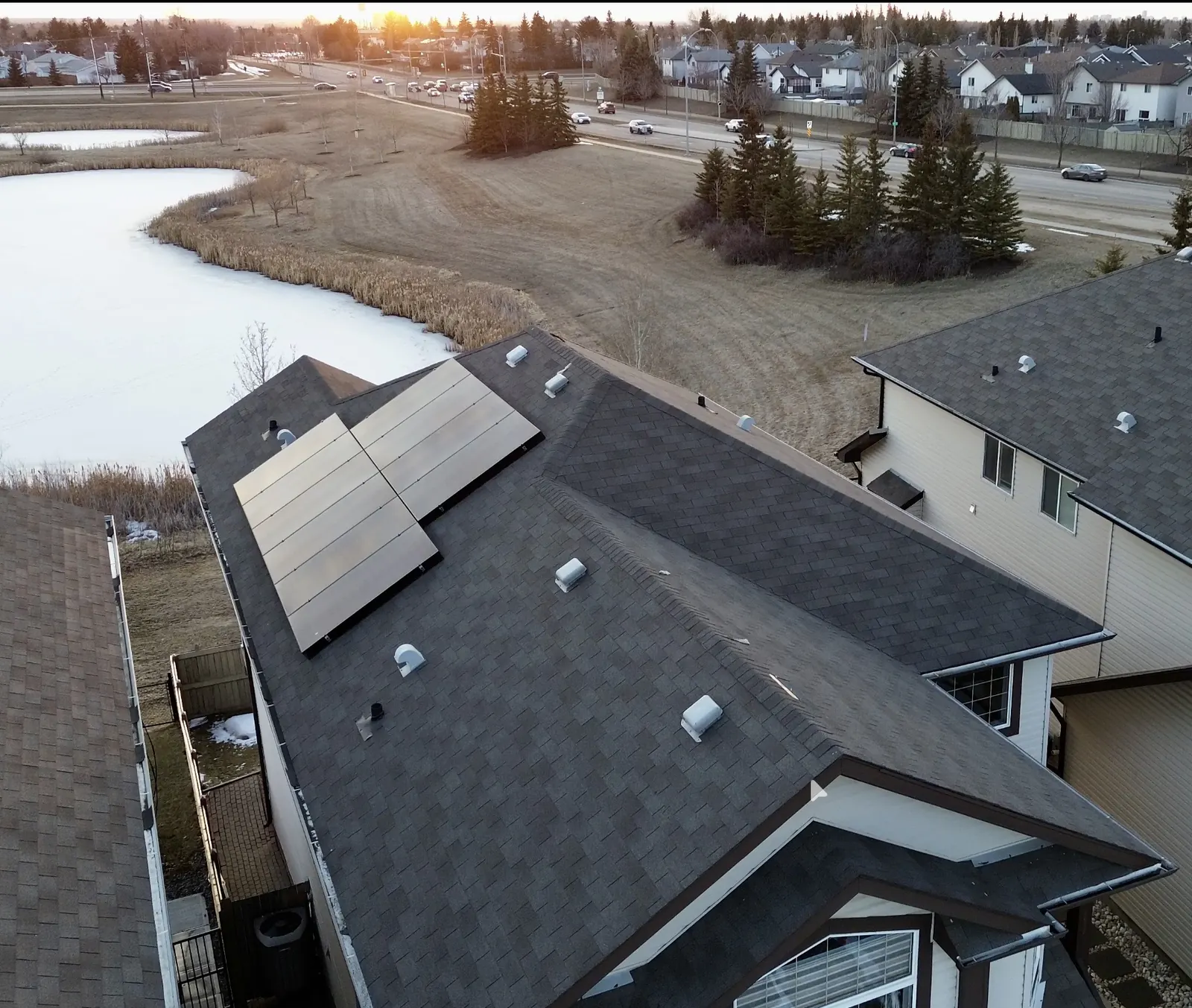
TL;DR. The best residential solar panel for Alberta in 2026 is the one your trusted installer standardizes on. Stellar Upgrades installs LONGi Hi-MO 7 500W across all 550+ Alberta projects since 2018 because of three Alberta-specific specs: −0.28%/°C temperature coefficient (best-in-class cold-climate behaviour), 5,400 Pa snow load, and a 30-year production warranty: among the longest output guarantees of the major tier-1 options. Credible tier-1 alternatives (arrange-able on request): Canadian Solar TOPHiKu7, Q CELLS Q.TRON, REC Alpha Pure, Silfab Prime. Real-world year-1 production differences between any two tier-1 brands fall within ±2%, installer quality and microinverter choice move payback far more than panel brand. For a full head-to-head: LONGi vs Canadian Solar vs Q CELLS comparison.
- Stellar's in-stock pick
- LONGi Hi-MO 7 500W bifacial, N-type cells, 25-year product warranty + 30-year power production warranty. This is what we install on every system.
- What matters in Alberta
- Cold-temperature coefficient (panels gain output below 25°C), snow load rating, manufacturer warranty backed by a balance sheet that will outlast a small installer.
- Tier-1 alternatives (arrange-able)
- Canadian Solar, Q CELLS (Hanwha), REC Group, Silfab (Canadian-made), Jinko Solar, Trina Solar. all credible. Stellar does not stock these in inventory; we can typically arrange them on request, subject to availability, lead time, and price difference vs the LONGi standard. Confirm at the free assessment.
- What rarely matters
- Efficiency differences of 0.5–1% between tier-1 brands. Marketing tier ("monocrystalline PERC" vs "TOPCon N-type" labels). Country of origin in isolation.
- What always matters
- Whether the installer pulls real permits, names a Master Electrician of record, and stays in business long enough to honour the workmanship warranty.
- Source of analysis
- Public manufacturer datasheets and 550+ Stellar Upgrades installs since 2018, Edmonton + ~200 km radius.
The 60-second answer
Most Alberta homeowners over-index on panel brand because that's the most visible decision in a solar quote. The truth is that at the top tier, panel-brand differences are smaller than installer differences. A great panel installed by a sloppy crew with no Master Electrician on the permit will underperform a slightly lower-tier panel installed by a careful crew that pulls real permits, flashes the roof correctly, and stays in business.
That said, panel choice does matter. For Alberta specifically, the four things that should drive your panel decision are:
- Cold-temperature coefficient: how much extra power the panel produces in cold weather. Better is more negative (e.g., −0.30%/°C is better than −0.35%/°C). Alberta is cold often; this matters more here than in Florida.
- Snow load rating: how much weight the panel can take without cracking. Look for at least 5,400 Pa (~110 PSF) front-side rating. Most tier-1 panels meet this.
- Linear degradation curve and product warranty: how much output the panel is guaranteed to retain at year 25 or 30. Modern tier-1 N-type panels guarantee 87–88% at year 30.
- Manufacturer financial stability: whether the company will still exist to honour your warranty. LONGi, Canadian Solar, Q CELLS (Hanwha), Jinko, and Trina all have enterprise-scale balance sheets. Some smaller brands don't.
The honest spec comparison: what fits Alberta best
Numbers below are pulled from publicly available 2025–2026 datasheets for each brand's current flagship residential platform. Numbers vary slightly by model and year; treat this as orientation. Not as a final-word spec sheet (you should always pull the latest datasheet for the specific SKU you're being offered).
| Brand & flagship platform | Cell tech | Wattage range | Module efficiency | Temp coeff. | Product warranty | Power warranty (yr 30) |
|---|---|---|---|---|---|---|
| LONGi Hi-MO 7 (Stellar in stock) | N-type TOPCon bifacial, HPDC | 500–590W | ~22.9% | ~−0.29%/°C | 25-year product | ~87.4% (30 yrs) |
| Canadian Solar TOPHiKu6 (residential, N-type) (on request) | N-type TOPCon | 440–470W | ~21–22.5% | ~−0.30%/°C | 25-year | ~87.4% (30 yrs) |
| Q CELLS Q.TRON / Q.PEAK DUO (on request) | N-type TOPCon (Q.TRON) or P-type (Q.PEAK) | 400–480W | ~21.6–22.5% | ~−0.30%/°C | 25-year (Q.TRON) | ~90.6% (yr 25) |
| REC Alpha Pure-R / Pure RX (REC-certified installer required) | N-type Heterojunction (HJT) | 410–480W | ~21.8–22.6% | ~−0.24%/°C (HJT advantage) | 25-year ProTrust (must be REC-certified installer) | ~92% (yr 25) |
| Silfab Prime / Elite (Canadian-made) (on request) | N-type TOPCon or P-type | 400–520W | ~21–22.1% | ~−0.30%/°C | 25-year (Prime) | ~87.8% (yr 30) |
| Jinko Tiger Neo (on request) | N-type TOPCon bifacial | 440–625W | ~22–23.2% | ~−0.29%/°C | 25-year product (Tiger Neo) | ~87.4% (yr 30, Tiger Neo) |
| Trina Vertex N (on request) | N-type TOPCon | 425–505W | ~22–22.8% | ~−0.29%/°C | 25-year (Vertex N) | ~88.5% (yr 30) |
The pattern. At the current state of the market in 2026, all seven brands above have converged on the same broad envelope: N-type TOPCon (or HJT for REC) cell technology, ~22% efficiency, ~−0.30%/°C temperature coefficient, 25-year product warranty, and a 30-year power production guarantee retaining 85–92% of nameplate. Any of them will perform credibly in Alberta. The meaningful differences are warranty terms and conditions, manufacturer longevity, and installer relationship. Not the watts or the efficiency.
Brand-by-brand: what each one is good at
A note on availability: Stellar keeps the LONGi Hi-MO 7 in stock as our standard panel, that's what we install on every system we quote at our $2.80/W cash price. The other brands below are credible tier-1 alternatives that we can typically arrange on request, subject to current Alberta supplier availability, lead time, and price difference vs the LONGi standard. We don't carry them in inventory the way we carry LONGi. If after reading this section you decide one of them is the right fit for your priorities, flag it at the free assessment and we'll quote the trade-off honestly.
LONGi Hi-MO 7 (Stellar's in-stock standard)
LONGi Green Energy is consistently one of the top three global solar manufacturers by shipped volume (rankings rotate among LONGi, Jinko, Trina, and JA Solar year-over-year). LONGi is China-headquartered and listed on the Shanghai Stock Exchange (601012.SS). The Hi-MO 7 is the company's flagship residential platform: N-type TOPCon bifacial cells using LONGi's Hybrid Passivated Dual-junction Cell (HPDC) architecture, in a half-cell module layout with dual-glass laminated construction and IP68-rated junction box. The platform launched in 2023 and ships at 500–590W per panel for current residential SKUs.
Key 2026 specs as installed by Stellar:
- 500W nameplate at STC; ~540–560W observed in Alberta winter at −10°C
- ~22.9% module efficiency
- 25-year product warranty + 30-year power production warranty, ~0.4%/yr linear degradation after year one, ~87.4% rated output at year 30
- 5,400 Pa front snow load (~110 PSF), 2,400 Pa back wind load
- Operating temperature −40°C to +85°C
- HPDC (Hybrid Passivated Dual-junction Cell) architecture; dual-glass laminated; IP68-rated junction box; N-type bifacial cells (Hi-MO 7 platform-wide)
Why Stellar picked it. Scale + balance sheet + 25-year product warranty is the right combination for a 25-year decision. The Hi-MO 7's bifacial design captures reflected light off snow and roof material, which adds a few percent of winter production at no extra cost. And the cold-temperature coefficient (~−0.29%/°C) is among the best in the residential market.
Canadian Solar (TOPHiKu6 residential, TOPHiKu7 commercial)
Despite the name, Canadian Solar is a multinational with its headquarters in Guelph, Ontario, and primary manufacturing in China and Brazil. For Alberta residential installs the relevant platform is the TOPHiKu6 (108-cell N-type TOPCon, 440–470W typical, 25-year product warranty, ~87.4% rated output at year 30). The TOPHiKu7 series is the larger-format 210mm-cell line built for commercial and utility-scale projects; it carries a 12-year enhanced product warranty plus 30-year linear performance warranty (different warranty structure than the residential TOPHiKu6). Canadian Solar's brand recognition in Canada is strong, and the TOPHiKu6's specs are directly comparable to LONGi Hi-MO 7. Some installers in Alberta stock Canadian Solar exclusively.
Q CELLS (Hanwha Q CELLS)
Q CELLS is owned by Hanwha (a Korean conglomerate). The Q.TRON line uses N-type TOPCon cells; the older Q.PEAK DUO line uses P-type. Q CELLS has a strong U.S. residential market presence and good year-25 power retention (~90.6% on Q.TRON), but the wattage range tops out lower than LONGi or Canadian Solar (typical residential ceiling around 480W). For a tight roof where panel count matters, that can be a constraint. Excellent panel in the U.S. residential market; less common in Alberta.
REC Group (Alpha Pure-R, Pure RX)
REC is Norwegian-founded, now owned by Reliance Industries (India). The Alpha series uses heterojunction (HJT) cell technology, which has the best temperature coefficient in the market (~−0.24%/°C versus ~−0.30 for TOPCon) and the best year-25 power retention (~92%). The catch: the REC ProTrust 25-year product warranty requires installation by a REC-certified installer, and the product is priced toward the premium end of the residential market. Beautiful panel. Pricier per watt. Excellent fit if your installer is REC-certified and you're optimizing for absolute cold-climate performance.
Silfab (Canadian-made)
Silfab manufactures in Mississauga, Ontario, and Bellingham, Washington. The "made in Canada" angle resonates with some Alberta buyers, and the panel quality is genuinely good. Wattage range is currently smaller than LONGi or Canadian Solar (residential models cap around 500–520W), but the year-30 power retention on the current Silfab Prime is competitive with the leading TOPCon platforms (~87.8%). Solid choice if local sourcing matters to you. Premium pricing for the made-in-North-America story.
Jinko Solar (Tiger Neo)
Jinko is one of the three largest solar manufacturers globally by volume (China-headquartered, listed on NYSE: JKS). The Tiger Neo platform uses N-type TOPCon cells and ships at very high wattages (up to ~625W per panel for the largest residential SKUs). Spec-for-spec comparable to LONGi Hi-MO 7. Tiger Neo carries Jinko's 25-year product warranty plus a 30-year linear power production warranty per Jinko's global limited warranty terms. Less common in Alberta residential installs than LONGi or Canadian Solar but a credible choice.
Trina Solar (Vertex N, Vertex S+)
Trina is another of the global top-three solar manufacturers by volume (China, NYSE-listed). The Vertex N platform uses N-type TOPCon cells. Specs are again directly comparable to LONGi and Jinko. Trina's warranty terms have improved meaningfully on Vertex N (25-year product). Less common in Alberta residential but credible. Some installers stock Trina exclusively for its higher wattages.
What about the brands you should be more careful about
Without naming specific companies (we don't trash competitors publicly), some patterns to watch for in a solar quote:
- "Tier 1" claim with no manufacturer named. "Tier 1" is a Bloomberg banking classification about bankability. Not a quality grade. Every brand on the comparison table above is tier 1. So is some lower-quality stock. Always ask for the specific manufacturer and SKU in writing.
- Sub-15-year product warranty. A panel with a 10- or 12-year product warranty is a panel the manufacturer doesn't fully stand behind. Acceptable on a 1990s install; not acceptable in 2026.
- "Off-brand" private-label panels. Some installers private-label panels from a manufacturer you can't easily verify. The warranty in that case is only as good as the installer's ability to honour it (i.e., the installer must stay in business; see the Alberta installer-bankruptcy section).
- P-type PERC at premium price. P-type PERC was the industry standard from ~2015 to ~2023, but N-type TOPCon and HJT panels have overtaken it on temperature coefficient and degradation. P-type can still be a good value buy at the right price; just don't pay premium pricing for last-generation cell technology.
How much do panels actually contribute to total system cost?
This is the question most homeowners don't ask. In a $2.80/W typical Alberta install ($19,600 range floor for a 7 kW system), the panel cost line itself is roughly $5,600–$7,000, about 30–35% of the total. The other ~65% is microinverters, racking, electrical work, labour, permits, engineering, mobilization, commissioning, and the leak-proof warranty (5-year Essential / lifetime Premium).
What this means: upgrading from a credible tier-1 panel to another credible tier-1 panel typically moves the total system price by 2–6%, not 20%. If a quote is materially cheaper than the rest of the market, the savings are coming from somewhere other than panel choice, usually from cheaper microinverters, omitted permits, subcontracted labour, or downgraded mounting hardware. Full cost breakdown in our solar panel cost in Alberta 2026 guide.
The microinverter / inverter question matters more than panel brand
Most Alberta homeowners spend hours comparing panel brands and minutes comparing inverter architecture, backwards. The inverter choice is more consequential to long-term production than the panel brand difference between two tier-1 manufacturers.
Module-level power electronics (MLPE): microinverters like the APsystems DS3 or DC power optimizers like SolarEdge, let every panel operate independently. Shade or snow on one panel doesn't drag down the rest of the array. That advantage routinely delivers 5–15% more annual production than a basic string inverter setup, especially on Alberta roofs with multi-plane geometry, dormers, or chimney shade. Stellar installs APsystems DS3 microinverters on every system. Full comparison: microinverters vs string inverters in Alberta.
What about hail? (Alberta-specific)
Edmonton, Calgary, and central Alberta sit in "Hailstorm Alley." Every modern tier-1 panel listed above is hail-tested to the IEC 61215 standard (25 mm ice ball at 23 m/s, multiple impact points). That standard catches a "typical" Alberta hailstorm. It does not catch the rare softball-sized hail events that occasionally pass through. For those, what matters is your home insurance policy. Not the panel rating. We cover the full hail question (panel testing, insurance carriers, claim documentation) in the Alberta hail and solar guide.
What about LONGi specifically: the "why we picked this" decision
Stellar's standardization on LONGi Hi-MO 7 wasn't a marketing decision. The rationale, plainly:
- Warranty credibility. A 25-year product warranty from a consistently top-three global solar manufacturer is among the most credible 25-year warranties in residential solar. LONGi's revenue base, balance sheet, and global manufacturing scale make warranty enforcement realistic in 2046. Smaller manufacturers can't make that promise as credibly.
- Cold-climate performance. The N-type bifacial Hi-MO 7 platform has one of the best temperature coefficients in the residential market (~−0.29%/°C). In Alberta, where average winter daytime temperature sits well below 25°C STC, this matters. Not for marketing reasons, but because the panel is producing 10–15% above nameplate per hour of sun on a typical cold-but-sunny winter day.
- Snow-load and wind ratings. 5,400 Pa front / 2,400 Pa back are at the top of the residential market for IEC-certified panels. Roof Tech's RT-MINI II mount is rated to 90 PSF ground snow and 180 mph wind; the combined system is built for Alberta.
- Aesthetic consistency. All-black backsheet / black-frame Hi-MO 7 panels look uniform across the array, important on south-facing residential roofs where the panels are part of the curb appearance.
- Real-world install history. Stellar has installed LONGi panels across all 550+ of our installs. We know how they behave on Alberta roofs across five Alberta winters. We don't have to guess.
That's the rationale. It isn't a slam on Canadian Solar or Q CELLS or REC, those are credible panels and they work fine in Alberta. It's the answer to "given that all tier-1 panels are now broadly comparable, which one optimizes for the highest-leverage Alberta-specific variables?"
What about reading a solar quote
When you get three Alberta solar quotes, the panel brand is going to vary. Some installers stock LONGi, some Canadian Solar, some Silfab, some Q CELLS, occasionally Jinko or REC. That brand variation is normal and doesn't disqualify a quote. What you should check, line by line, on every quote:
- Specific panel brand and SKU (not "tier 1 monocrystalline")
- Specific microinverter / inverter brand and SKU
- Specific mount brand and SKU (and its leak warranty)
- Specific manufacturer warranty terms on each component (product warranty separate from power warranty)
- Workmanship warranty term (5 or 10 year on most Alberta installers)
- Whether the price includes permits (city electrical + utility interconnection + structural where required)
- Master Electrician of record name and permit number on a previous install
- Whether the install crew is in-house or subcontracted
If any of those are vague or missing, ask for them in writing before signing. Our full installer vetting guide: how to choose a solar installer in Alberta, the 11 questions.
Frequently asked questions
Are LONGi panels good?
Yes. LONGi is consistently among the top three global solar manufacturers by shipped volume. Their Hi-MO 7 N-type bifacial platform is comparable spec-for-spec to other tier-1 panels like Canadian Solar TOPHiKu6, Jinko Tiger Neo, and Trina Vertex N. The Hi-MO 7 carries a 25-year product warranty plus 30-year power production warranty with ~87.4% rated output at year 30. Snow load 5,400 Pa front. Temperature coefficient ~−0.29%/°C. Operating range −40°C to +85°C.
Is Canadian Solar better than LONGi?
For Alberta residential installs in 2026, the two flagship platforms (LONGi Hi-MO 7 and Canadian Solar TOPHiKu6) are spec-for-spec comparable: N-type TOPCon cells, ~22% efficiency, similar temperature coefficient, 25-year product warranty, ~87% rated output at year 30. The choice usually comes down to availability with your installer and modest price differences. Canadian Solar has stronger brand recognition in Canada because of the name; LONGi has the larger global manufacturing scale.
Are Silfab panels worth the premium for being Canadian-made?
If country of origin matters to you for non-financial reasons, yes. The current Silfab Prime is competitive on year-30 power retention (~87.8% per Silfab product literature), though wattage ceiling on residential SKUs (~520W) is below the higher-wattage LONGi or Canadian Solar tiers (590W+). Silfab's panels are well-built and warrantied; you're paying ~5–10% more for the made-in-North-America story. Reasonable choice.
Are Q CELLS still a top choice for residential solar?
Yes. Q.TRON is a strong N-type TOPCon panel with excellent year-25 power retention (~90.6%). The constraint in Alberta is that residential SKUs top out lower than LONGi or Canadian Solar (~480W vs 590W+), so for a tight roof where panel count matters, Q CELLS may not be the best fit. For typical residential applications it's a credible choice.
What's the best solar panel for cold weather?
Cold improves the per-hour output of every photovoltaic panel; "best for cold" comes down to temperature coefficient. REC Alpha (HJT cells) has the best at ~−0.24%/°C, followed by LONGi Hi-MO 7, Canadian Solar TOPHiKu6, Jinko Tiger Neo, and Trina Vertex N all clustered around ~−0.29 to −0.30%/°C. In Alberta the practical difference between LONGi and REC over 30 years is roughly 2–3% of cumulative production, meaningful but not decisive.
How long do solar panels actually last?
Modern tier-1 panels are warranted for 30 years of linear power production (LONGi Hi-MO 7 guarantees ~87.4% of nameplate at year 30; REC Alpha Pure guarantees ~92% at year 25). In practice, well-installed panels routinely deliver 30+ years of useful production. Inverters typically retire first (microinverters at 20–25 years; older string inverters at 10–15). Roof mounts carry a leak-proof guarantee (5-year Essential / lifetime Premium) on a good install. Batteries are the shortest-lived component at 10–15 years.
Does panel wattage matter or just total system size?
For a roof with unlimited space, panel wattage doesn't matter, what matters is total kW of system capacity. For Alberta residential roofs with limited south-facing area, higher-wattage panels (500–590W LONGi or Canadian Solar) let you fit more capacity on the same roof. A 500W panel needs the same footprint as a 400W panel of the same form factor but produces 25% more power.
What about bifacial vs monofacial panels in Alberta?
Bifacial panels (LONGi Hi-MO 7, Jinko Tiger Neo) have a transparent back sheet that captures reflected light. In residential rooftop installs the bifacial gain is modest (1–5% extra production) because the roof underneath reflects relatively little light. The bifacial gain is much larger on ground-mount and bifacial-optimized racking (10–15% extra). The bifacial design also helps with thermal management. For Alberta residential rooftops, the bifacial advantage is real but small; for ground-mount or farm installs it's significant.
Are Chinese-made solar panels safe?
Yes, in the sense that they are manufactured to identical IEC certification standards (IEC 61215 for testing, IEC 61730 for safety) regardless of country of origin. The largest solar manufacturers globally, LONGi, Jinko, Trina, Canadian Solar, are all China-headquartered or have primary China manufacturing. They supply tier-1 panels to NASA, U.S. utilities, European energy companies, and major Canadian installers. The "is it safe" question conflates country of origin with quality; in practice, certification and warranty terms are what matter.
What's the difference between "product warranty" and "power warranty"?
Product warranty covers manufacturing defects (cell cracks, junction box failures, frame issues). Power warranty guarantees a minimum production level over time (e.g., "≥87.4% of rated output at year 30"). Modern tier-1 panels typically carry a 25-year product warranty and a 30-year power production warranty. Older P-type panels often had a 12-year product warranty with 25-year power. Always check both numbers separately on a quote.
Does it matter that the panel brand on my quote isn't LONGi?
No, provided the brand is tier 1, the SKU is current N-type or HJT cell tech, the product warranty is 25 years, and the manufacturer has the balance sheet to honour it. The seven brands compared in this guide all meet that bar. The decisions that matter more are: who's installing it, whether they pull real permits, and whether they'll still be in business in year 20. Stellar's own quotes default to LONGi (what we stock); if you want a different tier-1 brand, ask at the assessment and we'll quote it on request based on current availability and price difference.
Does Stellar install only LONGi panels?
LONGi Hi-MO 7 is our standard, in-stock panel, what we install on every system we quote at the $2.80/W cash price. We can arrange other tier-1 panels (Canadian Solar, Q CELLS, Silfab, Jinko, Trina) on request, subject to current Alberta supplier availability, supplier lead time, and price difference vs LONGi. REC Alpha requires installation by a REC-certified installer, which Stellar can sometimes coordinate through a partner. Flag your panel preference at the free assessment so we can quote it accurately.
Should I delay buying to wait for better panel technology?
No. The current generation of N-type TOPCon and HJT panels has narrowed the gap to the theoretical ceiling for silicon cells. Future gains will come from perovskite tandems, commercial residential availability is at minimum 3–5 years out and will arrive at a price premium. Meanwhile every year you delay solar is a year of unoffset electricity bills at $2,400–$4,800 per typical Alberta home. The math against waiting is decisive.
Bottom line
For Alberta in 2026, the panel that goes on your roof matters less than most quotes will lead you to believe. Stellar installs the LONGi Hi-MO 7 500W on every system because we believe it's the best fit for Alberta-specific variables (cold-temperature coefficient, snow load, manufacturer warranty credibility, real-world install history) and because standardizing across one platform lets our in-house Master Electrician and crew do the same install every time, which is how workmanship warranties stay clean.
Other tier-1 brands are credible. If your installer quotes Canadian Solar, Q CELLS, REC, Silfab, Jinko, or Trina with the right SKU and 25-year product warranty, you're getting a good panel. The decision that drives your 25-year outcome is who's installing it. Not whether the box says LONGi.
Want a panel recommendation matched to your specific roof, your electricity bill, and your budget? Stellar offers a free 30-minute home assessment. Our senior team walks you through the actual panel layout for your roof and gives you a fixed installed price with no upcharges. Book your free assessment or call (780) 200-5265.
Sources. LONGi Hi-MO 7 product page and ENF Solar datasheet aggregator (LR5-66HTH and LR5-72HTH series); Canadian Solar TOPHiKu6 datasheet (CS6.1-54TM-H, 445–470W, NA) and TOPBiHiKu7 datasheet (CS7N-TB-AG, commercial); Q CELLS Q.TRON BLK M-G2+ datasheet (Hanwha Q CELLS, 415–440W); REC Alpha Pure-R / Pure RX product literature and ProTrust warranty documentation; Silfab Prime product page and SolarReviews comprehensive review; Jinko Tiger Neo product literature and Jinko Global Limited Warranty; Trina Vertex N datasheet (TSM-NEG19RC); IEC 61215 photovoltaic module qualification standards; IEC 61730 safety standards; Stellar Upgrades internal install records (550+ residential systems since 2018, Edmonton + ~200 km radius). Specs subject to change; verify the latest datasheet for the specific SKU on your quote before signing.