TL;DR. An Alberta power bill is two bills stapled together. The first is the energy charge — the kilowatt-hours you actually used — and it's the only part you can lower by switching retailers. The second is delivery and fees: transmission, distribution (with a fixed daily charge), rate riders, and the municipal local access fee, all regulated by the Alberta Utilities Commission and identical no matter who you buy power from. On a typical Edmonton residential bill, that second half is often as big as or bigger than the electricity itself, which is exactly why your bill feels disconnected from how much power you use. You can attack the energy half three ways: get off the default Rate of Last Resort, use less, or generate your own with solar + net metering (which zeroes the energy charge but not the fixed connection costs). You can't shop the delivery half — you can only stop buying as many kilowatt-hours through it.
I get a version of this question almost every week, usually with a photo of a bill attached: “We barely ran anything this month — how is this $260?” It's a fair question, and the answer isn't “you used more than you think.” The answer is that most Albertans have never had the bill itself explained to them, line by line, by someone who isn't trying to sell them a cheaper rate that only touches a third of it.
So that's what this is. I'm an electrician, not a power retailer — we wire solar, batteries and EV chargers across the Edmonton region — which means I have no rate plan to push on you. I just read these bills for a living when we size systems. Here is every line on an Alberta residential power bill, what it actually pays for, which parts you can change and which you can't, and where solar genuinely helps versus where it's oversold.
Want us to read your actual bill and model the residual? →
Flip the equation with solar
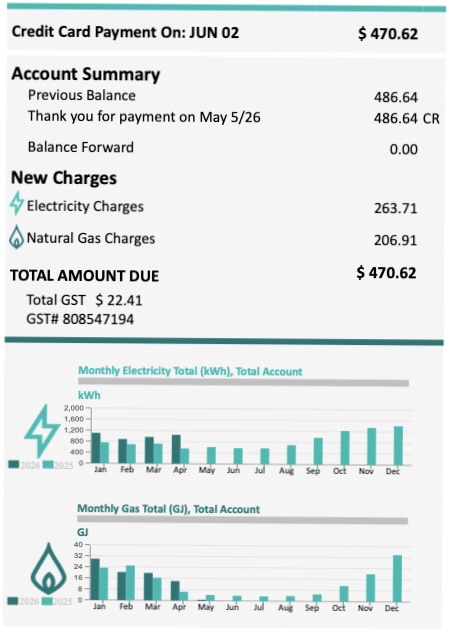
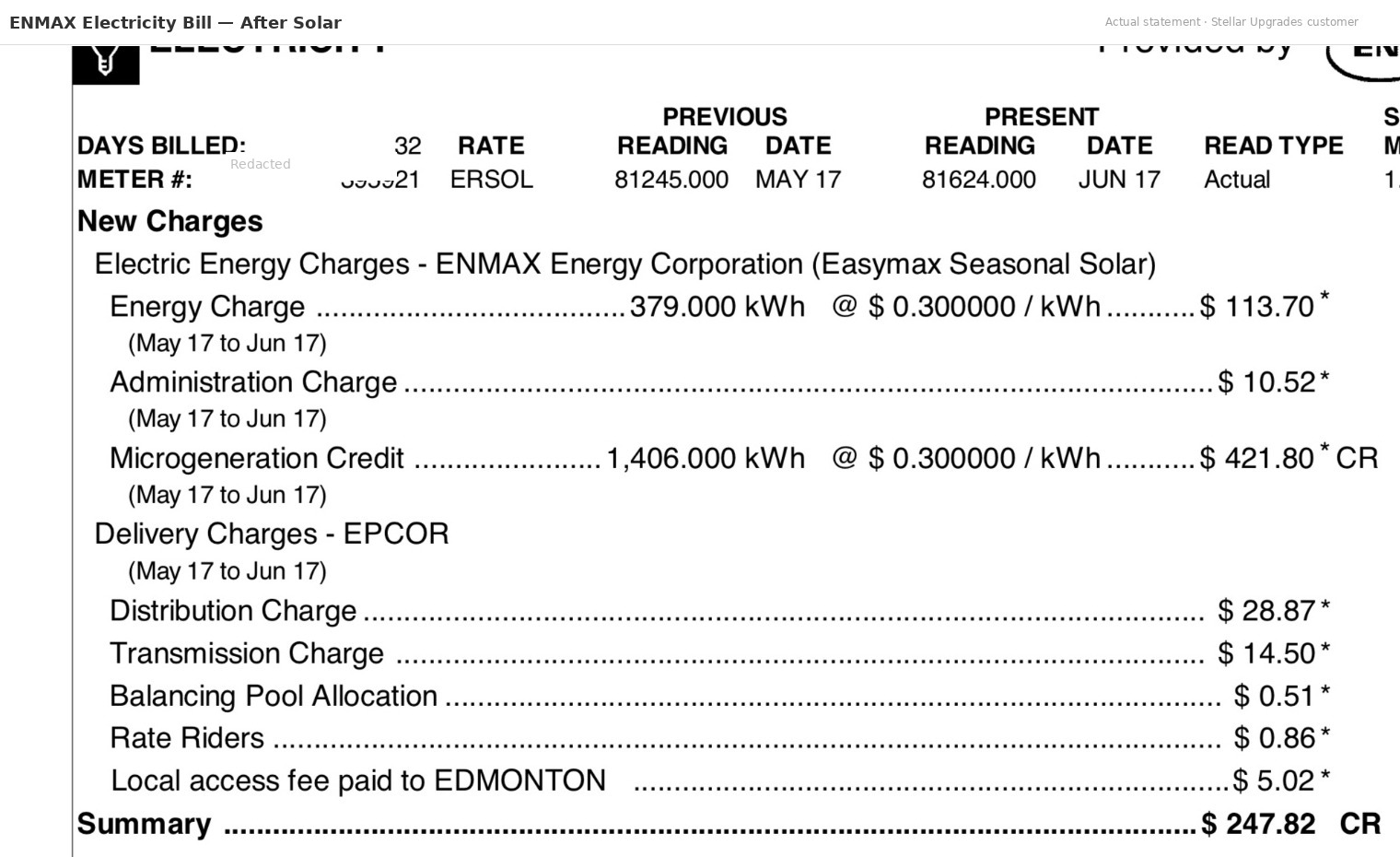
Two real Alberta bills. Left: a typical pre-solar month — $263.71 owing on the electricity side alone. Right: a Stellar Upgrades customer in North Edmonton whose meter ran backward into a $247.82 credit (May–June 2025). Same grid, same delivery charges — net metering and a high summer rate just changed who pays whom.
First, the thing nobody tells you: Alberta is deregulated
Alberta is one of only two places in North America (Texas is the other) with a fully deregulated, energy-only electricity market. In most of Canada, a single Crown utility generates the power, owns the wires, and sends you one simple regulated bill. Here, those jobs are split among different companies, and your bill is the receipt for all of them.
That split is the root of nearly every “why is this so high” question. When you pay BC Hydro or Manitoba Hydro, you pay one entity one rate. When you pay an Alberta bill, you're paying:
- a retailer for the electricity itself (you can choose this company — EPCOR, Encor, ATCOenergy, Park Power, Direct Energy and a dozen others);
- the AESO (Alberta Electric System Operator) for the high-voltage transmission grid;
- your wires utility for local distribution — EPCOR Distribution in Edmonton, FortisAlberta or ATCO Electric elsewhere — and you don't get to choose this one; it's whoever owns the poles on your street;
- your municipality, through the local access fee;
- and the federal government, through GST.
Deregulation was supposed to give you choice and competition. It did — but only on the energy line. Everything else is a regulated monopoly you're connected to whether you like it or not. Keep that in mind, because it explains why the “lock in a low rate!” ads you hear on the radio can only ever fix one slice of the problem.
The two halves of your bill
Forget the dozen line items for a second. Every Alberta residential bill divides cleanly into two buckets.
| Bucket | What's in it | Can you change it? |
|---|---|---|
| Energy (the “electricity” you bought) | Electricity / energy charge, retailer administration charge | Yes — shop retailers, change rate plan, or generate your own with solar |
| Delivery & fees (getting it to you) | Transmission, distribution (incl. a fixed daily charge), rate riders, local access fee | No — regulated by the AUC, set by your wires utility and city, same for every retailer |
| Tax | GST 5% on everything above | No |
Here's the part that surprises people: on a typical Edmonton residential bill, the delivery & fees bucket is roughly the same size as the energy bucket — sometimes larger, especially in a low-usage month. You are paying about as much to have electricity delivered as you are for the electricity. That single fact is the honest answer to “why is my bill so high.”
A real Edmonton bill, line by line
First, here's what most people actually see — a real Alberta bill, with the personal details stripped off:
That summary view — one tidy “Electricity Charges” number — is exactly why the bill feels like a black box. So let's pry it open. Take a normal Edmonton home using 700 kWh in a winter month (a gas-heated house running lights, a furnace fan, a fridge, laundry and the usual electronics). Here's how that single electricity number breaks down at typical 2026 Edmonton residential rates. Your exact figures will differ by retailer and rate plan, but the shape is what matters.
| Line item | Bucket | ~Amount | Share |
|---|---|---|---|
| Electricity / energy charge (700 kWh × ~12¢ RoLR) | Energy | ~$84 | ~40% |
| Administration charge (flat) | Energy | ~$11 | ~5% |
| Transmission charge | Delivery | ~$33 | ~16% |
| Distribution charge (fixed daily + per-kWh) | Delivery | ~$45 | ~21% |
| Rate riders (true-up, balancing pool, etc.) | Delivery | ~$5 | ~2% |
| Local access fee (municipal franchise fee) | Delivery | ~$18 | ~9% |
| GST (5%) | Tax | ~$10 | ~5% |
| Total | ~$206 | 100% |
Illustrative breakdown for a 700 kWh winter month at typical 2026 Edmonton residential rates (energy at the ~12¢/kWh Rate of Last Resort). Actual line items, rate-rider values and the distribution fixed/variable split vary by retailer and by EPCOR tariff period. Sources: EPCOR “Understand Your Bill” and distribution/transmission tariff schedules; Alberta Utilities Commission; Utilities Consumer Advocate (Government of Alberta); Government of Alberta Rate of Last Resort.
Add it up by bucket and the story is stark: ~$95 of energy (the part you can shop) versus ~$101 of delivery and fees (the part you can't), plus GST. The electricity you actually consumed is less than half the bill. Switch to the cheapest retailer in the province and you're competing over that top ~40%. The bottom 60% doesn't move.
The energy charge — the only part you can shop
This is the kilowatt-hours you used times your rate. It's the part everyone fixates on, and fairly so — it's the only line a retailer can actually compete on. Your options in 2026:
- Rate of Last Resort (RoLR) — the default. If you've never signed a contract, you're on it. ~12¢/kWh, fixed through Dec 31, 2026.
- Competitive fixed rate — a contract with a retailer at a locked ¢/kWh, often below RoLR. Predictable; you're protected from spikes but won't benefit from dips.
- Competitive variable / floating rate — tracks the wholesale market month to month. Cheap when the pool price is low, brutal when it isn't (ask anyone who was on a floating rate in the summer of 2023).
- Seasonal solar plan — only relevant once you own solar. A high rate in summer and a low rate in winter, applied to both the power you buy and the power you sell. More on that below.
About the Rate of Last Resort (and why it has a new name)
On January 1, 2025, the province replaced the old Regulated Rate Option (RRO) with the Rate of Last Resort (RoLR). The RRO was the rate that made headlines in 2022–2023 when it spiked past 30¢/kWh in some months and the bills genuinely hurt. It changed every single month and was effectively a bet on the wholesale market that households kept losing.
The RoLR fixes that volatility: it's set for two-year terms and can move at most 10% at the end of each term. As the name now bluntly says, it's a last resort — a backup for people who haven't chosen a plan, not a reward for loyalty. If you're on it by default, treat that as a prompt to compare a competitive fixed contract. For most households the fixed contract wins on the energy line, and if you're going solar, a seasonal solar plan wins by a wider margin still.
The delivery charges — the part you can't shop (and that keeps climbing)
Here's where the bill gets its weight, and where switching retailers changes nothing. These charges are set by your wires utility and approved by the Alberta Utilities Commission. Every retailer passes them through identically.
Transmission
This pays for the high-voltage backbone — the big steel towers moving power from generators across the province to your local substation, operated through the AESO. It's billed largely on your usage. The uncomfortable trend: Alberta's transmission costs have roughly doubled over the past decade as the province built out and reinforced the grid. Those capital projects get recovered from ratepayers for years, which is why this line keeps creeping up even when the price of electricity itself is flat. You did not get a vote on those projects, and you can't opt out of paying for them — but every kilowatt-hour you don't pull from the grid is a kilowatt-hour you don't pay transmission on.
Distribution
This is your local wires utility — the poles, transformers and lines on your actual street, run by EPCOR in Edmonton or FortisAlberta / ATCO Electric in other regions. It's typically the biggest single delivery line, and it has two parts:
- a fixed daily charge you pay just for being connected — this is the one that makes a near-zero-usage month still cost real money; and
- a variable per-kWh charge on what you draw.
Distribution is also why rural and acreage bills run higher. The same length of line that serves a city block might serve one home out of town, so the per-customer cost of the system is simply larger. If you're on an acreage watching your distribution line every month, that's not an error — it's the math of low density, and it's a big reason rural solar tends to pencil out so well.
Rate riders
These are the small adjustment lines — transmission true-ups, balancing-pool allocations, and similar corrections that reconcile what was forecast against what actually happened. Individually minor, collectively a few dollars, and entirely out of your hands.
The local access fee — the line that quietly punishes Calgary
This one deserves its own moment, because almost nobody understands it. The local access fee is a franchise fee: your city charges the utility for the right to run wires across municipal land and through public right-of-way, and the utility passes that cost straight to you. It's a municipal revenue source dressed up as a utility charge.
The kicker is how it's calculated, which differs by city:
- In Edmonton, the local access fee is a percentage of your delivery (transmission + distribution) charges. It rises and falls with the cost of the wires.
- In Calgary, it's tied to the energy rate — so when electricity prices spiked in 2022–2023, Calgary's franchise fee spiked right along with them. Calgary households ended up paying multiples of what Edmonton households paid for the very same line item, and it became a genuine civic controversy.
The point for you: this is a real, often-substantial charge that has nothing to do with the electricity market and everything to do with your municipality's formula — and no retailer switch touches it. The only lever you have is the size of the charges it's calculated on, which loops back to using and importing fewer kilowatt-hours.
What this means in your town
The delivery half of your bill depends on which company owns the poles on your street — and that's decided entirely by where you live, not by anything you can choose. Here's who runs distribution across our service area, and roughly what it means for your bill:
| Your area | Wires (distribution) utility | Bill note |
|---|---|---|
| Edmonton | EPCOR Distribution | Local access fee is a % of delivery; urban density keeps distribution moderate |
| St. Albert, Spruce Grove, Stony Plain, Leduc, Beaumont | FortisAlberta | Different distribution tariff & franchise-fee formula than Edmonton |
| Sherwood Park & Strathcona County | FortisAlberta | Suburban + acreage mix; rural addresses pay more distribution |
| Fort Saskatchewan, Morinville, Devon & most central-AB towns | FortisAlberta | Town vs surrounding acreage changes the distribution share |
| Red Deer | City of Red Deer (municipally owned) | City-run wires & its own franchise treatment |
| Northeast & northern rural Alberta | ATCO Electric (in many areas) | Long rural lines — distribution is often the biggest single line |
| Acreages & farms (any region) | Whoever owns the rural line | Lowest customer density = highest per-kWh distribution cost |
Distribution-utility assignment is set by service territory, not by choice. Confirm yours on your bill or your wires utility's site. The energy charge and rate options are the same province-wide; the delivery lines differ by territory. See your town's page for local install details, or our full service-area list.
The takeaway is the same everywhere: you can't change your distribution utility, and you can't shop the delivery charges it sets. Whether you're on EPCOR in Edmonton, Fortis in Sherwood Park, or a long rural ATCO line out past Cold Lake, the only lever that shrinks that half of the bill is importing fewer kilowatt-hours through it. The further out you are, the bigger that lever gets — which is exactly why rural and acreage solar so often produces the best numbers we model.
So what actually lowers an Alberta bill?
Four levers, in rough order of how much they move the needle. Be wary of anyone selling you only one of them.
1. Get off the default rate (free, five minutes)
If you're on RoLR by default, comparing competitive fixed-rate contracts is the no-cost first move. It only touches the energy line (~40% of the bill), but it's free and it's real. The Government of Alberta's Utilities Consumer Advocate publishes a neutral rate comparison; use it. This won't transform your bill, but it stops you overpaying on the one part you control.
2. Use fewer kilowatt-hours (modest, with a ceiling)
LED everything, a smart thermostat, sealing the envelope, not heating an empty house — all worth doing. But notice the ceiling: efficiency shrinks the energy charge and the variable slice of delivery, while the fixed connection costs sit there unmoved. Past a point, you're conserving hard for diminishing returns. Useful, not transformative.
3. Generate your own with solar + net metering (the big one)
This is the lever that changes the bill's structure instead of nibbling at one line. Under Alberta's Micro-Generation Regulation, a grid-tied solar system runs your meter backward when you produce more than you use. Over a properly sized year, the kilowatt-hours you export cancel the ones you import, and your energy charge falls to roughly zero on a net annual basis. Because you're pulling far fewer kWh from the grid, the usage-based portion of transmission and distribution drops too, and so does the slice of the local access fee that rides on them.
Now the honest part, because this is exactly where the industry oversells. Solar does not erase:
- the fixed daily distribution charge (you're still connected to the grid — that connection is what lets you bank summer surplus against winter);
- the flat administration charge; or
- the fixed component of the local access fee.
What that means for your bill depends on your rate plan and on sizing. On a flat-rate or default plan, net-metering credits offset the energy charge but those fixed charges usually remain, so a realistic outcome is a bill cut down to a small monthly connection cost. On a seasonal solar plan with a system correctly sized to your last 12 months of use, summer exports credited at the high rate build a bank that is designed to cover winter use at the low rate and those fixed charges. Designed for a $0 annual power bill on a seasonal solar plan at today’s rates (40¢/kWh April–October, 5.29¢/kWh November–March), with a system sized to your last 12 months of use. Rates can change. That is an annual result: winter bills still show charges, which the summer credit then covers. If a salesperson promises “no more power bill, ever,” ask them to show you the rate plan and sizing behind it, and the line items on a real customer's post-install bill. We do that on every quote, because the math works strongly in solar's favour when it's told straight: you're trading a permanent, escalating ~$200/month bill for a financed system that pays itself off and then keeps producing for decades. The number that matters most is the 25-year total.
4. Seasonal solar rates: turn your roof into the high-priced retailer
Once you own solar, a seasonal solar plan flips the deregulated market in your favour. The same rate applies to the power you buy and the power you sell in each season, and it is high in summer and low in winter — for example, 40¢/kWh April–October and 5.29¢/kWh November–March. You sell your July afternoon overproduction high and buy your December evening power low. It's the one place Alberta's market design genuinely rewards a homeowner — and it's only available to micro-generators. For a solar owner it can take years off the payback period compared with a flat-rate plan. You choose your own retailer. Solar Club is a separate seasonal-style program with its own rates; see our Solar Club guide.
Send us your worst bill
We'll break it into the same buckets you just read about, model what solar would zero out and what would stay, and show you how the result depends on your rate plan and sizing — no overpromising. Free, no obligation, fixed price the same day.
Get My Free Bill Review →What about a battery? (The honest Alberta answer)
People assume a home battery lowers the bill. In most of the world it does, by storing cheap off-peak power and using it during expensive peak hours — classic time-of-use arbitrage. Alberta residential customers don't have time-of-use rates. A kilowatt-hour costs the same at 2 p.m. as it does at 2 a.m. So there's no cheap-versus-expensive window to arbitrage, and a battery does essentially nothing to your monthly bill.
What a battery buys in Alberta is resilience — keeping your furnace, fridge and well pump running when the grid drops, which it increasingly does. After the province pushed an emergency alert to every phone in January 2024 and ran actual rotating outages that April, a lot of Albertans started taking backup seriously. That's a legitimate reason to buy one. “It'll lower my bill” is not. We spell out the real runtime math in our grid-alert guide, and if anyone tells you a battery pays for itself on bill savings in Alberta, walk away.
The bill that's coming: your next vehicle
One more thing, because it's the fastest-growing line on Alberta bills I see. An EV adds roughly 3,000–4,000 kWh/year to a household — that's a 30–50% jump in electricity use for many homes, and it lands entirely on the energy and variable-delivery lines. The flip side: charging at home is still dramatically cheaper than gasoline, and if you charge a solar-plus-Solar-Club home, you're effectively fuelling the car on your own midday surplus. We ran the full per-vehicle math in EV charging cost in Alberta. If an EV is on your horizon, size the solar for it now — it's the cheapest time to do it.
Putting it together: why your neighbour's bill is different
Two identical houses, two very different bills. The usual reasons, now that you can read the lines:
- Rate plan — one's on RoLR by default, the other locked a competitive fixed rate (energy line differs).
- City — different local access fee formula and different distribution utility (Edmonton vs Calgary vs a Fortis town).
- Urban vs rural — the acreage pays more distribution for the same kWh.
- Heating fuel — a gas-heated home and an all-electric home aren't remotely comparable on the energy line.
- Solar — one of them quietly zeroed the top 40% of the bill and is selling July sunshine back at 40¢ on a seasonal solar plan.
The one-line summary
Your Alberta power bill is high because less than half of it is electricity. The rest is the regulated cost of the wires, the towers, the city's franchise fee and tax — charges no retailer can discount and that keep climbing as the grid gets built out. Switching rates trims the shoppable slice. The only move that shrinks the whole bill is to stop pulling so many kilowatt-hours through that expensive delivery system — which is precisely what a well-sized solar array does, honestly and permanently, while a battery handles the outages and never pretends to lower the bill.
Flip the equation with solar
From owing $263.71 to a $247.82 credit — that’s the half of the bill solar actually flips. Same grid, same delivery charges; net metering and a high summer rate changed who pays whom.
Want the honest version for your house?
Send us a recent bill, or book a free 30-minute assessment. We'll show you the two buckets on your bill, model exactly what solar would zero out and what fixed costs would remain, and give you a fixed installed price the same day — the same approach we've taken across 550+ installs since 2018 in Edmonton, Sherwood Park, St. Albert, Spruce Grove, Stony Plain, Leduc, Beaumont, Fort Saskatchewan, Red Deer and every community within ~200 km of Edmonton. No overpromising: we show you exactly which rate plan and system size the result depends on. Just the real math.
Get your free Alberta bill review & solar quote →
Sources. Alberta Utilities Commission (regulated delivery tariffs, Rate of Last Resort framework); AESO transmission cost reporting; EPCOR distribution tariff schedules; City of Edmonton local access fee framework (franchise fees); retailer rate sheets for the energy-charge comparisons; a real anonymized Edmonton residential bill reproduced with the customer’s permission.