TL;DR. A correctly installed solar array does not damage a healthy Alberta roof — industry data puts install-related leaks at under 1% of systems, and essentially all of them are workmanship failures, not panel problems. The physics runs the other way: panels shield the shingles beneath them from the UV, hail, and freeze-thaw cycling that kill Alberta roofs, and UC San Diego measured 38% less heat flux through the deck under PV. The two real risks are (1) an old roof going in — re-roof first if your shingles have less than ~10 years left, because removing and resetting panels later costs $200–$300 each — and (2) a crew that treats roof attachment as an afterthought. Screen for both with the 7 questions below. Stellar installs ICC-certified self-flashing mounts with no pilot holes and backs every install with a leak-proof roof guarantee — five years on the Essential package, lifetime on Premium.
Of the objections we hear across 550+ Alberta installs since 2018, this one is second only to “what does it cost”: you want to put how many holes in my roof? It’s a fair question. Your roof is the single most expensive wear item on your house — $8,000–$15,000 to replace a typical Edmonton home’s shingles in 2026 — and Alberta weather is genuinely hard on it.
So here is the complete answer, with the load numbers, the certification paperwork, the roof-age decision table, and the costs nobody puts in a brochure. By the end you’ll know more about solar roof attachment than most salespeople who’ll ever knock on your door — which is exactly the point.
The short answer, and where the risk actually lives
Solar panels themselves cannot damage a roof. They’re inert laminated glass sitting on aluminum rails 10–15 cm above the shingles. Every real-world solar roof problem — and industry data across millions of installs puts leak callbacks at under 1% of systems — comes from one of two places:
- The roof was already at end of life, and someone bolted 25-year hardware onto 3-years-left shingles.
- The attachment work was sloppy — sealant-only penetrations instead of flashing, fasteners that missed the rafter, shingle seals broken by careless foot traffic.
Both of those are screenable before you sign anything. Neither is a property of solar. They’re properties of who you hire — the same conclusion our installer-vetting guide reaches from every other direction.
How panels actually attach to an Alberta shingle roof
The part of the install nobody photographs is the part that decides whether your roof stays dry for 25 years. On a standard asphalt-shingle roof — which is most of Edmonton, Sherwood Park, St. Albert and everywhere else we work — the stack is four layers:
- Structure location. The crew finds the rafters or trusses under the deck. Fasteners go into structure (or engineered deck attachment), never just plywood by guesswork.
- The mount. This is where installers differ most, and it’s the heart of this post — see the next section.
- Rails. Aluminum rails bolt to the mounts and span between attachment points.
- Panels. The modules clamp to the rails, wiring secured up off the shingle surface.
The traditional mount — still common in Alberta — is a lag bolt through a metal L-foot, sealed with caulk, sometimes with a metal flashing slid under the shingle course above. Done carefully, it works. But it has failure modes: caulk ages in Alberta’s -35°C to +30°C annual swing, pilot holes are drilled before sealing, and sliding flashing under brittle cold-weather shingles breaks the shingle’s self-seal strip.
What we install instead: the self-flashing mount
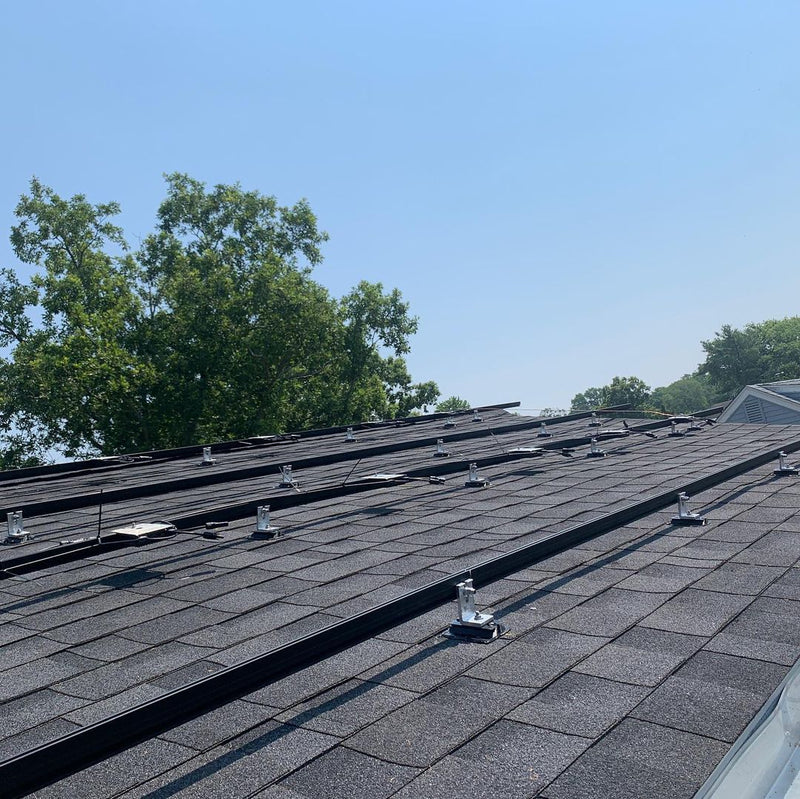
Stellar standardized on the Roof Tech RT-MINI II — part of the same equipment stack (panels, microinverters, mounts) spec’d on our solar service page for every install — and the reasons are all verifiable on paper rather than our word:
| Spec | RT-MINI II | Why it matters in Alberta |
|---|---|---|
| Flashing | Integrated AlphaSeal butyl — seals around the fastener | No caulk-only penetrations to age out in freeze-thaw; nothing slid under brittle shingles |
| Pilot holes | None — fastened with wood screws | No open hole exists at any point during the install |
| Certification | ICC-ES evaluation report ESR-3575 | Third-party engineering evidence, not marketing — ask any installer for their mount’s report number |
| Wind rating | Up to 180 mph | Far beyond any recorded Alberta wind event |
| Snow rating | Up to 90 PSF ground snow | ~2.5× the Edmonton-area design ground snow load (~1.7 kPa / ~35 PSF) |
| Attachment | Rafter or deck mount, engineered spacing | Flexible layout without compromising hold-down values |
One honest caveat so you can trust the rest of this post: no mounting product makes a bad crew safe. Self-flashing hardware removes the most common failure modes — aged caulk, open pilot holes, broken shingle seals — but the install still has to hit structure and follow the engineering. Hardware plus an in-house crew under a Red Seal Master Electrician of record is the full answer; either half alone is not.
“Can my roof even hold that?” — the weight math
This one dissolves the moment you put numbers on it. A complete residential solar system — LONGi Hi-MO 7 panels, rails, mounts — adds roughly 11–14 kg/m² (2.3–2.9 lb/ft²) of evenly distributed dead load over the array area.
| Load on an Edmonton-area roof | Approx. magnitude |
|---|---|
| Complete solar array (panels + rails + mounts) | ~2.3–2.9 lb/ft² (11–14 kg/m²) |
| Design ground snow load, Edmonton area (building-code climatic data) | ~35 lb/ft² (1.7 kPa) |
| LONGi Hi-MO 7 module front-load rating (snow) | 5,400 Pa — ~113 lb/ft² on the panel itself |
| RT-MINI II mount rating | Up to 90 PSF ground snow, 180 mph wind (ICC-ESR-3575) |
Read that top line against the second one. The array adds less than a tenth of the snow load your roof structure is already engineered to carry every winter under the Alberta Building Code. And this isn’t left to arithmetic on a blog: every Stellar install goes through municipal permit review — City of Edmonton ePermits or your local authority — which includes the structural check. If a specific roof ever genuinely couldn’t take an array, the process is designed to catch it, and the honest answer is to say so and walk away rather than reinforce a deal that shouldn’t happen. The panel spec comparison has the full module-level load data if you want to go deeper.
The part nobody tells you: panels protect the roof underneath
What ages an Alberta asphalt shingle? Three things: UV exposure (dries the asphalt, sheds the granules), hail (bruises the mat, strips granules), and thermal cycling (Alberta roofs swing through -35°C to +60°C surface temperatures across a year, and expansion-contraction fatigue cracks the material). A solar array is, functionally, a shield against all three for the section it covers:
- Heat & UV: UC San Diego’s Jacobs School of Engineering measured 38% less heat flux reaching the roof deck under PV panels, with the ceiling below running about 3°C (5°F) cooler — the panels absorb and re-radiate the sun’s energy while airflow in the gap carries heat away (Dominguez, Kleissl et al., Solar Energy, 2011).
- Hail: the tempered dual-glass module takes the impact instead of the shingles. Panels are certified to IEC 61215 (25 mm ice balls at 23 m/s), and after Alberta hail events we routinely find the shingles under arrays in visibly better condition than the exposed roof around them — the full hail data, insurance carriers, and claim process are in our Alberta hail guide.
- Thermal cycling: a shaded, ventilated shingle simply swings through a smaller temperature range every day than one in full sun.
The practical consequence shows up at re-roof time: roofers in solar markets routinely find the array footprint is the best-preserved section of a 20-year-old roof. The panels don’t just not damage the roof — over a 25–30 year system life, they meaningfully slow the aging of the part they cover.
Not sure what shape your roof is in?
Every free Stellar assessment includes a roof condition check before we quote — age, wear, hail history, structure. If your roof isn’t ready for solar, we’ll tell you that instead of selling you a system.
Book My Free Roof + Solar Assessment →The real decision: your roof’s age, not the panels
Here’s the honest framing. The question isn’t “will solar hurt my roof” — it’s “does my roof have enough life left to carry a 25–30 year asset?” Alberta context first:
- Architectural asphalt shingles in a prairie climate realistically last 18–25 years; basic 3-tab, 15–20.
- Hail regularly cuts that short — the Edmonton region sees meaningful hail every 2–3 years on average, and plenty of Alberta roofs are replaced (on insurance) well before year 15.
- A typical Edmonton re-roof in 2026 runs $8,000–$15,000 for a 1,500–2,000 ft² home, more for large or complex roofs.
- Removing and reinstalling a solar array to re-roof under it costs $200–$300 per panel — call it $3,000–$6,000 for a typical 12–16 panel home — covering electrical disconnect, removal, storage, remounting, and recommissioning.
That last number is the whole reason this decision exists. Put the array on a roof with 5 years left, and you’ve bought a $3,000–$6,000 surcharge on a re-roof you already knew was coming. So:
| Shingle age | Our recommendation | Why |
|---|---|---|
| 0–5 years | Install — ideal window | Roof and array age together; covered shingles age slower than exposed ones |
| 5–10 years | Install after a condition check | Normally 10–20 years of shingle life left — comfortably clears the decision horizon |
| 10–15 years | Judgment call — inspect first | Condition beats age: granule loss, curling, and hail history decide it, not the calendar |
| 15+ years, or visible wear / major hail event | Re-roof first, then solar | Avoids the $3,000–$6,000 remove-and-reset; new shingles + new array = matched 25-year clocks |
Two notes that make the re-roof-first path less painful than it sounds. First, coordinating the re-roof with the solar install means the mounts go onto fresh shingles with full manufacturer warranty, and the roofer and solar crew sequence the work in the same week — we do this routinely with Edmonton-area roofers. Second, if hail ends your roof after solar is up, most Alberta home policies treat roof-mounted solar as part of the dwelling: the detach-and-reset belongs in the insurance claim, not on your credit card. Confirm it with your carrier in writing at install time — the hail guide walks through exactly how.
Roof type by roof type
| Roof surface | Solar-ready? | Attachment method |
|---|---|---|
| Asphalt shingle (most Alberta homes) | Yes — the standard case | Self-flashing deck/rafter mounts (RT-MINI II), no pilot holes |
| Standing-seam metal | Yes — the best solar roof there is | Seam clamps. Zero penetrations — not one hole |
| Exposed-fastener metal (acreage shops, barns) | Yes | Purpose-made rib brackets with butyl backing — engineered, gasketed penetrations |
| Flat / low-slope | Yes, with engineering | Ballasted or anchored racking per structural review |
| Clay tile / aged cedar shake | Generally no | Brittle surfaces crack under install traffic — usually better to re-roof to a solar-friendly surface first |
If you’re rural and the best roof on the property is a shop or barn — or none of them — a ground mount sidesteps the roof question entirely; that trade-off is covered in the acreage & farm solar guide.
What about my shingle warranty?
A properly flashed, properly fastened penetration does not void a shingle manufacturer’s warranty across the roof — shingle warranties cover manufacturing defects, and they continue to do so around a correctly installed mount. What actually creates warranty trouble is workmanship: unsealed holes, shingle seal strips broken by prying in cold weather, granule damage from careless foot traffic. In other words, the same story as everything else in this post — the risk is the crew, not the concept.
The layered coverage on a Stellar install works like this: the shingle manufacturer covers the shingles; LONGi covers the panels (25-year product / 30-year production); Roof Tech’s certified mount system covers the hardware; our installation warranty covers the labour; and our leak-proof roof guarantee — five years on Essential, for the life of the roof on Premium — covers the thing you actually care about — water staying outside. The full decode of what each layer covers, and what happens when something breaks, is on the warranty page.
The 7 questions that expose weak roof workmanship
Ask these of any installer quoting your roof — ours included. Strong companies answer all seven in writing without flinching; this list is the roof-specific companion to the 11-question installer vetting checklist.
- What mount hardware do you use — brand and model? (“Standard L-feet” with no brand is a yellow flag.)
- What’s its ICC-ES evaluation report number? (Ours: ESR-3575. An installer who can’t name one is guessing at engineering.)
- Do you drill pilot holes through my roof deck, and what seals each penetration? (Caulk alone is a 10-year answer to a 25-year question.)
- Rafter mount or deck mount, and how do you locate structure?
- Who is physically on my roof — your employees or a subcontractor? (A contracted crew has no incentive to come back when a flashing weeps two winters later.)
- What exactly does your leak coverage say, and for how long? (Get the document, not the sentence.)
- If the roof leaks at a penetration in year 6, who pays — and does that survive if your company is sold or shuts down?
The bottom line
Your roof is a reasonable thing to worry about — and the worry points at the right target only when it lands on installation quality, not on solar itself. The data says a correctly mounted array leaks essentially never, weighs a fraction of what your roof is engineered for, and leaves the shingles underneath in better shape at year 20 than the ones beside them. The two genuine risks — an end-of-life roof going in, and careless attachment work — are both fully screenable before you sign: check the roof’s age against the table above, and put the 7 questions to every bidder. If solar makes financial sense for you (the full 2026 worth-it analysis is here, and the current pricing here), your roof is very unlikely to be the reason it doesn’t.
Get the roof answer for your actual roof
Free 30-minute assessment, Edmonton and everywhere within ~200 km: we check shingle age and condition, hail history, structure and shading before we quote — and if the honest answer is “re-roof first” or “wait,” that’s the answer you’ll get. If the roof is ready, you’ll see the Edmonton pricing, the mount hardware spec, and the leak-proof guarantee (5-year Essential / lifetime Premium) terms on one page, the same way we’ve quoted 550+ installs since 2018.
Get your free roof + solar assessment →
Sources. ICC-ES Evaluation Report ESR-3575 and Roof Tech RT-MINI II technical documentation (AlphaSeal, wind/snow ratings); UC San Diego Jacobs School of Engineering and the underlying paper, Dominguez, Kleissl et al., Solar Energy (2011) (38% roof heat-flux reduction); National Building Code climatic data for Edmonton-area design snow loads; LONGi Hi-MO 7 datasheet (5,400 Pa front load); IEC 61215 module qualification standard; Edmonton roofing cost guides (2026) and Canadian solar remove-and-reinstall market pricing; Stellar Upgrades install records, 550+ Alberta systems since 2018.