TL;DR. Edmonton council has raised the franchise fee the city collects through EPCOR from 17.65% to 19.4%, starting January 1, 2027. On your bill it is the Local Access Fee, charged on every kilowatt-hour you pull from the grid. For a typical household it is about a dollar a month more; for a home with an EV or electric heat, a bit more than that; for a large commercial building, thousands. It is not a reason to panic. It is one more line on the half of the bill you cannot shop, arriving in the same month the Rate of Last Resort resets and EPCOR’s distribution rates adjust. Below: exactly what was decided, what it costs at your usage, what else changes in 2027, and the three levers that actually move an Edmonton bill, ranked honestly.
I read Edmonton power bills for a living. Not as a retailer with a rate to sell you, but as an electrician who sizes solar, battery and EV charger installs off the kilowatt-hours on the page. Council has just voted on a fee most people have never noticed on their bill, and the questions it raises are predictable: “Is this the big increase everyone’s talking about? How much is it, really? Can I get out of it?”
Here are the straight answers, with every number traced to a city report, an EPCOR filing, an Alberta Utilities Commission (AUC) decision or the news coverage of the vote. Where I have done my own arithmetic, I say so.
Want your 2027 bill modelled from your actual EPCOR bill? Free, same day →
What council actually decided on October 6
On Tuesday, October 6, 2026, Edmonton City Council voted 8–5 to raise the municipal electricity franchise fee from 17.65% to 19.4% of distribution charges, effective January 1, 2027. The motion came from Ward Karhiio Coun. Keren Tang. Councillors Erin Rutherford, Karen Principe, Thu Parmar, Mike Elliott and Reed Clarke voted against it.
The city’s Utility Committee had first proposed going to 20%, which is the maximum the AUC allows a municipality to charge. Tang argued for 19.4% instead because it matches what city staff described as the going rate in Calgary and in neighbouring Spruce Grove and Stony Plain. Her words, as reported by CBC: “I find it a bit more defensible for me to have it more in line with some of the other cities rather than just arbitrarily at a maximum.”
The case for: it is one of the few revenue tools a city has, and the alternative is property tax. Coun. Michael Janz backed it as a way to ease pressure on taxes; Coun. Jon Morgan said the alternative was to collect the same money through taxes and called the fee the better route. The case against: Rutherford pointed to cost of living and the volatility of Alberta’s energy market; Elliott said a small-looking fee compounds over time and could nudge new businesses to set up just outside city limits.
What administration told council it means in dollars:
| Scenario | Typical household | City revenue |
|---|---|---|
| Today (17.65%) | $9.06/month (city report baseline); EPCOR’s 2026 forecast average is $8.33/month | — |
| Approved: 19.4% | “A bit more than a dollar” a month more, per administration | About $20 million a year more, per administration |
| Rejected: 20% | $9.06 → $10.27/month (+$1.21) | +$14.8 million in 2027, to $125.6 million total |
Sources: City of Edmonton administration figures as reported by CBC News, CTV News Edmonton and Taproot Edmonton (October 6–7, 2026); EPCOR’s November 2025 franchise fee rate application. The revenue estimates for the two scenarios were reported by different outlets and do not line up neatly; we quote them as reported rather than reconcile them.
The timeline, start to finish
| When | What happens |
|---|---|
| March 17, 2025 | The 17.65% fee takes effect under the City–EPCOR franchise agreement approved by the AUC. The old agreement’s formula had worked out to about 15.3%; the city set 17.65% to match the Edmonton-metro average. |
| November 2025 | EPCOR files the 2026 per-kWh rates with the AUC. No change to the percentage; average household fee forecast to rise from $7.94 to $8.33 a month. |
| October 6, 2026 | Council votes 8–5 to move to 19.4% on January 1, 2027. |
| November 2, 2026 | The city’s draft 2027–2030 budget is released; council deliberates in December. |
| November 2026 (expected) | EPCOR files the 2027 per-kWh franchise fee rates with the AUC, as it does each fall. |
| By early December 2026 | The 2027–28 Rate of Last Resort must be filed with the AUC at least 30 days before January 1. |
| January 1, 2027 | New franchise fee, new Rate of Last Resort term, and EPCOR’s 2027 distribution rates all land on the same bill. |
What the franchise fee is (and why your bill calls it the Local Access Fee)
EPCOR has the exclusive right to run the wires that deliver electricity inside Edmonton. In exchange, it pays the city a franchise fee for using municipal land and rights-of-way. EPCOR does not absorb that fee. It flows straight through to every customer inside city limits, labelled Local Access Fee on the bill. It is municipal revenue collected through a utility bill.
Three mechanics matter for what you pay:
- It is a percentage of EPCOR’s distribution tariff revenue, meaning the regulated delivery charges on the bill, not the electricity itself. The AUC permits a municipality to set that percentage anywhere from 0% to 20%. Edmonton is going from 17.65% to 19.4%.
- It reaches you as a flat per-kilowatt-hour charge. EPCOR takes the dollar amount the percentage produces, divides it by forecast consumption, and files one $/kWh rate for distribution-connected customers (homes and most businesses) and another for the handful of transmission-connected industrial sites. In 2025 those were 1.324¢/kWh and 0.582¢/kWh. EPCOR’s 2026 forecast of $8.33 a month on 7,200 kWh a year works out to roughly 1.39¢/kWh (our arithmetic).
- It rides on imports only. The rate applies to the energy delivered to your meter from the grid. Kilowatt-hours you never pull through the meter carry no fee at all, which is the whole reason this matters for solar owners (more below).
Two housekeeping notes. GST applies on top of the fee, as it does on the whole bill. And this decision is about electricity only; Edmonton’s natural gas franchise fee is a separate item and was not part of this vote.
The Calgary comparison, done fairly
Council’s 19.4% was justified partly as matching Calgary. Worth knowing: Calgary’s fee used to float with the old Regulated Rate Option, which is why Calgarians paid multiples of Edmonton’s fee during the 2022–23 price spike. Since January 1, 2025 Calgary charges a flat $0.015507/kWh (about 19.2% of distribution tariff charges, per the city’s public notice), and the City of Calgary forecast its average residential fee at $7.91 a month for 2025. In other words, both big cities now charge the fee the same way, per kilowatt-hour, and after January Edmonton’s rate will sit in the same neighbourhood as Calgary’s.
What it costs at your usage
Because the fee is per kilowatt-hour, your increase scales with how much you import. Here is the fee at 2026 and 2027 rates across typical Edmonton usage levels. The 2027 column assumes EPCOR’s delivery charges are otherwise unchanged, so treat it as an illustration, not a quote; EPCOR’s actual 2027 $/kWh will be in its fall filing.
| Monthly use | 2026 fee (17.65%) | 2027 fee (19.4%) | Extra per year |
|---|---|---|---|
| 400 kWh (condo, small bungalow) | $5.55 | $6.10 | +$6.60 |
| 600 kWh (EPCOR’s average home) | $8.33 | $9.16 | +$9.90 |
| 800 kWh (family home, gas heat) | $11.11 | $12.21 | +$13.20 |
| 1,000 kWh (larger home, A/C) | $13.88 | $15.26 | +$16.50 |
| 1,200 kWh (home + EV) | $16.66 | $18.31 | +$19.80 |
| 1,500 kWh (large home + EV or electric heat) | $20.83 | $22.89 | +$24.80 |
Our arithmetic. 2026 rate derived from EPCOR’s forecast of $8.33/month on 7,200 kWh/yr (about 1.388¢/kWh); 2027 rate scaled by 19.4 ÷ 17.65 (about 1.526¢/kWh). Before GST. The city’s own “typical household” baseline is $9.06, slightly above EPCOR’s average, because the two use different assumptions; applied to $9.06 the increase is about $0.90 a month.
To put the line in context, here is roughly where it sits on a 600 kWh Edmonton bill at published 2026 rates, with the customer on the default Rate of Last Resort:
| Line | Basis | ~Amount |
|---|---|---|
| Energy charge | 600 kWh × 12.01¢ (RoLR) | $72.06 |
| Administration charge | 23¢/day × 30 | $6.90 |
| Distribution | 72.856¢/day × 30 + 1.783¢ × 600 kWh | $32.56 |
| Transmission | 3.825¢ × 600 kWh (2025 schedule) | $22.95 |
| Local Access Fee (2026) | ≈ 1.388¢ × 600 kWh | $8.33 |
| GST (5%) | on everything above | $7.14 |
| Total | before rate riders | ≈ $150 |
Illustrative. Energy and admin from EPCOR Energy Alberta’s Edmonton Rate of Last Resort tariff (12.01¢/kWh, $0.230/day); distribution from the AUC’s 2026 interim EPCOR residential schedule (DAS-R1 $0.72856/day, DAS-R2 $0.01783/kWh); transmission from EPCOR’s 2025 residential system access rate (SAS-R1 $0.03825/kWh), the latest published figure we could access. Rate riders vary month to month and are excluded. Your retailer, contract and billing days will change the exact totals.
So the Local Access Fee is roughly 5–6% of the pre-tax bill, and the January increase adds about half a percent to the total. If someone tells you this vote is why your bill jumped by $40, they are wrong. If your bill jumps by $40 in January, look at the energy rate and the distribution line first; this fee will account for about a dollar of it.
Businesses are a different story. Small commercial sites pay the same $/kWh as homes, so a shop running 5,000 kWh a month is looking at about $80 more a year. Pre-vote reporting on the 20% scenario put the average increase at roughly $31,500 a month for post-secondary institutions and about $10,400 a month for the largest commercial buildings, such as tall office towers and entertainment complexes. The approved 19.4% is a little under those figures, but the point stands: for a large roof, the fee alone is a five-figure annual line.
Preview your 2027 bill from your 2026 bill
Send a recent EPCOR bill (photo or PDF). We’ll show you the fee at 19.4%, flag whether you’re on the default rate, and model what solar would and wouldn’t remove. Free, no obligation, same day.
Get My Free 2027 Bill Preview →Everything else changing on Edmonton power bills in 2027
The franchise fee is the one change that is decided. Several others land in or around the same month, and the honest status of each is below. We will update this table as decisions are published.
| Item | What’s happening | Status (Oct 9, 2026) |
|---|---|---|
| Franchise fee → 19.4% | City of Edmonton decision; EPCOR files the per-kWh rate with the AUC | Confirmed — Jan 1, 2027 |
| Rate of Last Resort reset | The default energy rate (12.01¢/kWh at EPCOR) is fixed for two-year terms. Term 2 runs Jan 1, 2027 – Dec 31, 2028; the rate must be filed with the AUC at least 30 days before January 1 and can move at most 10%, so roughly 10.8–13.2¢. | Scheduled — amount not yet published |
| EPCOR distribution rates | Annual adjustment under the AUC’s 2024–2028 performance-based regulation plan (an inflation-minus-productivity formula plus capital trackers). The 2026 decision came December 10, 2025; expect the 2027 one around the same time. | Scheduled — amount not yet published |
| Transmission (AESO) | Annual rates continue. The big redesign of how transmission costs are allocated is due to be filed by January 31, 2027, with new rates expected in 2029. | No redesign in Jan 2027 |
| Restructured Energy Market | Alberta’s wholesale market overhaul (day-ahead market, locational pricing for generators, higher offer caps). Initial rules approved March 12, 2026; amended rules targeted for ministerial approval by Q2 2027; implementation targeted for mid-2027. Most consumers keep paying a single Alberta-wide price; what reaches you depends on your retail contract. | Mid-2027 target |
| Data centre demand | The Pembina Institute’s August 26, 2026 analysis modelled $267–$462 a year more (15–25%) for an average household from 2027 to 2031 because a large Sturgeon County data centre draws grid power before its own gas plant runs. The provincial government and the proponent dispute it. A provincial levy on data centres of 75 MW or more starts December 31, 2026. | Modelled risk, disputed |
Sources: AUC Decision 29204-D02-2025 (Rate of Last Resort price-setting plans, 2025–2028) and the Utilities Consumer Advocate; AUC Decision 30298-D01-2025 (EPCOR 2026 annual PBR rate adjustment); AESO engage, ISO Tariff Redesign and REM ISO Rules pages (September 2026); Government of Alberta and AESO REM announcements; Pembina Institute media release, August 26, 2026; law-firm summaries of the Financial Statutes Amendment Act (No. 2), 2025.
Read that table from the point of view of someone deciding what to do, and the structure is clear. The energy line (Rate of Last Resort or your contract) is the only piece you can shop, and it could go either way in January. Everything else is set by council, the AUC or the AESO, and the direction over the past decade has been one way: the retailer Direct Energy’s own bill explainer notes that transmission charges have roughly doubled over ten years, and the UCA puts distribution at about 24% and transmission at about 15% of a typical Alberta bill.
What you can actually do about it, ranked
1. Don’t drift into 2027 on the default rate (free, ten minutes)
If you have never signed an electricity contract, you are on the Rate of Last Resort. It is a two-year safety net, not a deal, and it resets in January with a cap of 10% either way. The Government of Alberta’s Utilities Consumer Advocate runs a neutral cost comparison tool that lists every retailer’s fixed and floating offers for your postal code. Check it before the new term starts. This only touches the energy line, which is roughly half the bill, but it is free and it is real.
2. Trim the kilowatt-hours (modest, with a ceiling)
Because the franchise fee, the variable distribution charge and the transmission charge are all billed per kWh, every kilowatt-hour you stop using saves you about 1.5¢ + 1.8¢ + 3.8¢ of delivery on top of the roughly 12¢ of energy. LED lighting, a smart thermostat, a furnace-fan setting that isn’t “always on,” a block-heater timer: all worth doing. The ceiling is the fixed stuff. The $0.73-a-day distribution charge and the admin fee don’t care how frugal you were.
3. Stop importing the kilowatt-hours in the first place (the structural lever)
This is where the per-kWh mechanics of the fee turn into a design decision. Under Alberta’s Micro-Generation Regulation, a grid-tied solar system on your roof reduces what you import in two ways:
- Daylight self-use. The power your panels make while the fridge, furnace fan, A/C or EV charger is running never crosses the meter. No energy charge, no transmission, no variable distribution, no franchise fee on those kWh. A home without a battery uses a minority of its production this way; a battery raises it (the standard review of the research found a battery sized at 0.5–1 kWh per kW of solar lifts on-site use by 13–24 percentage points).
- Exports credited against imports. The surplus goes to the grid and is credited at your retailer’s rate; on a Solar Club plan, summer exports earn a high export credit (around 35¢/kWh) while you import at a low rate. Credits cancel the energy charge dollar for dollar. They do not erase the per-kWh delivery lines or the franchise fee on the kWh you still import on winter evenings.
Put numbers on it for the average Edmonton home at 7,200 kWh a year with a 6 kW array (12 of the 500 W LONGi panels we install), which produces about 7,200 kWh a year at Edmonton’s 1,200 kWh-per-kW baseline. If a third of that production is used on-site, imports fall by about 2,400 kWh. At 2027 rates that is roughly $37 a year less franchise fee, about $135 less in variable distribution and transmission, and the energy charge on those kWh gone. The remaining production is exported and credited. The franchise fee saving is pocket change; the bill-level math is in the energy charge and the export credits, which is why a well-sized system pays for itself in roughly eight years on Solar Club. Run your own numbers in the free Alberta solar calculator and then check them against a real bill with us.
The honest residual: solar does not remove the fixed daily distribution charge, the retailer admin fee, or the franchise fee on whatever you still import. Anyone promising a $0 Edmonton bill is overselling. A near-zero energy cost plus a small connection cost is the realistic outcome, and it still beats a permanent, escalating bill. If you want the fuller version of what solar does and doesn’t fix, our line-by-line bill breakdown covers it.
4. Don’t buy a battery to dodge this fee
Yes, a home battery raises daylight self-use and therefore trims imports and the per-kWh fees on them. But Alberta has no residential time-of-use rates to arbitrage, and on a Solar Club plan, exporting a summer kilowatt-hour at roughly 35¢ beats storing it to avoid about 19¢ of import costs. A battery in Edmonton is for keeping the furnace, fridge and sump pump running through an outage or a grid alert. That is a good reason to own one. Saving a dollar a month on a franchise fee is not.
5. If an EV is coming, size for it now
An electric vehicle adds roughly 3,000–4,000 kWh a year to a household, all of it imported if you charge from the grid. At the 2027 rate that is about $45–$60 a year of franchise fee alone, before the energy and delivery charges on the same kWh. Charging a solar-plus-Solar-Club home on its own midday surplus changes that math completely. We run the per-vehicle numbers in EV charging cost in Alberta, and if you are adding a Level 2 charger, the time to size the array for it is before the install, not after.
6. If you own a commercial roof, this is a budget line
The fee is per kWh for every distribution-connected site, so a 100,000 kWh-a-month building is looking at roughly $1,650 more a year from this change alone, on top of a delivery side that is already most of the bill. Our commercial solar guide covers what a warehouse, office or multi-tenant roof actually pencils out to in Alberta.
Does this affect Sherwood Park, St. Albert or Spruce Grove?
No. The franchise fee is a City of Edmonton charge collected by EPCOR on sites inside city limits. Surrounding communities set their own franchise fees with their own wires owner, which for Sherwood Park, St. Albert, Spruce Grove, Stony Plain, Leduc, Beaumont and Fort Saskatchewan is FortisAlberta. City staff cited Spruce Grove and Stony Plain as already sitting around the 19.4% level, which tells you this is a regional norm, not an Edmonton outlier. Wherever you live, the lever is the same: the fee rides on imported kilowatt-hours, and you control how many of those there are.
Why a one-dollar fee is worth twelve minutes of your time
Taken alone, this vote changes a typical bill by less than a cup of coffee a month. I am not going to pretend otherwise, and you should be suspicious of any installer who does. The reason it is worth understanding is what it tells you about the shape of your bill. Less than half of an Edmonton bill is electricity. The rest is the regulated cost of the wires, the towers, the city’s franchise fee and tax, set by council, the AUC and the AESO, and it has moved in one direction for a decade. Council has just told you, in the most explicit way possible, which direction it expects that half to keep moving: the fee was raised because the alternative was raising taxes.
Switching retailers trims the shoppable slice. Conservation trims the variable slice. The only move that changes the whole structure is to stop pulling so many kilowatt-hours through that delivery system, which is precisely what a properly sized rooftop array does, quietly, for 25 years, while the fee percentage and the rate riders do whatever they are going to do.
The half of the bill solar flips
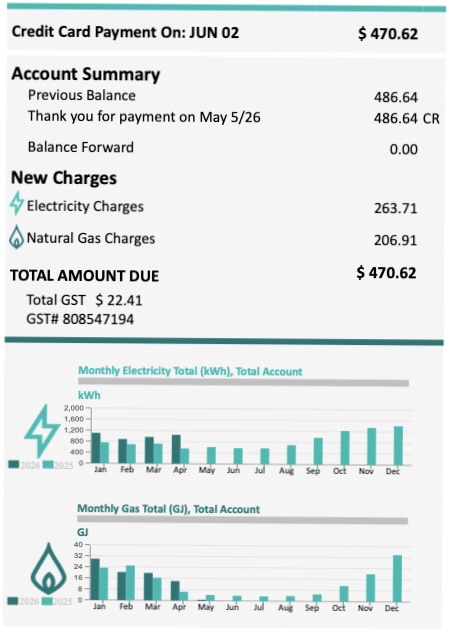
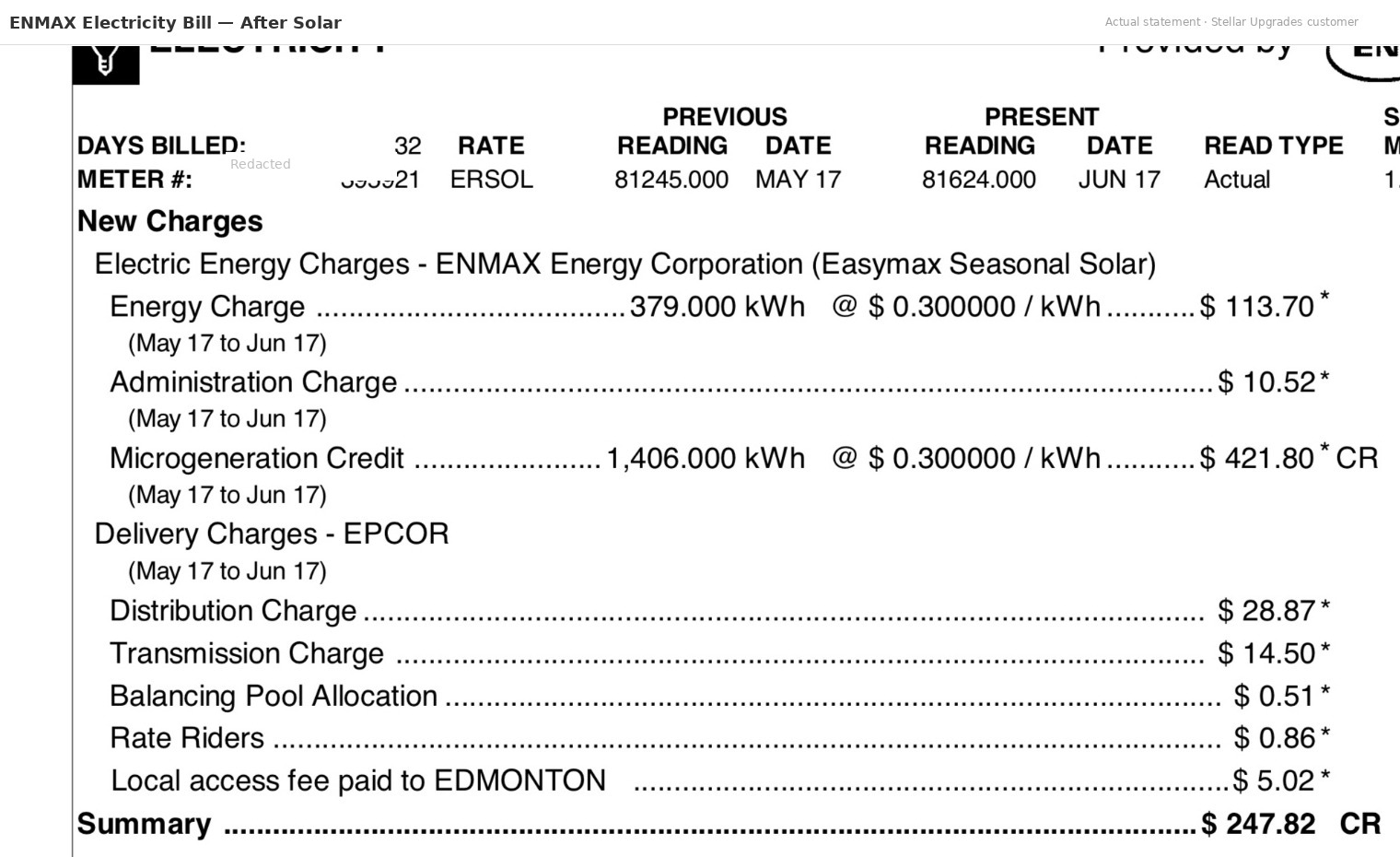
Two real Alberta bills. Left: a typical pre-solar month, $263.71 owing. Right: a Stellar Upgrades customer in North Edmonton whose meter ran backward into a $247.82 credit (May–June 2025). The franchise fee is still on the second bill. It is just riding on far fewer kilowatt-hours.
Want the honest version for your house?
Send us a recent EPCOR bill, or book a free 30-minute video consult. We will show you the two halves of your bill, what the 19.4% fee does to it in January, whether you are sitting on the default rate, and exactly what solar would zero out versus what would remain, with a fixed installed price the same day. It is the same approach we have taken across 550+ installs since 2018 in Edmonton, Sherwood Park, St. Albert, Spruce Grove, Stony Plain, Leduc, Beaumont, Fort Saskatchewan, Red Deer and every community within about 200 km of Edmonton. No “$0 bill” promises. Just the real math, and if the math doesn’t work for your roof, we will tell you that too; we turn down about one assessment in ten for that reason.
Get your free 2027 bill preview & solar quote →
Sources
- CBC News, “Edmontonians could face higher power bills after city council votes to raise electricity franchise fee” (October 2026).
- CTV News Edmonton, “Edmonton power bills to bump up after city approves fee hike” (October 2026).
- Taproot Edmonton, Headlines: Oct. 7, 2026.
- Yahoo News Canada (syndicated), “Large businesses and post-secondary institutions could see five-digit utility fee hike if Epcor franchise fee increase approved” (pre-vote, October 2026).
- EPCOR, Electricity Franchise Fee 2026 Rate Application (November 15, 2025) and the City of Edmonton Notice of Application.
- Alberta Utilities Commission, EPCOR Distribution & Transmission Inc. 2025 franchise fee application for the City of Edmonton (17.65% of distribution tariff revenue; 2025 rates of $0.01324/kWh and $0.00582/kWh).
- Alberta Utilities Commission, EPCOR Distribution & Transmission 2026 interim distribution access service rate schedule; EPCOR, 2025 System Access Service tariff; AUC Decision 30298-D01-2025 (2026 annual PBR rate adjustment).
- EPCOR, Residential Rate of Last Resort, Edmonton; AUC, Decision 29204-D02-2025 (Rate of Last Resort price-setting plans, 2025–2028); Utilities Consumer Advocate, Rate of Last Resort.
- Utilities Consumer Advocate (Government of Alberta), Residential electricity delivery charges and Micro-generation; Government of Alberta, Micro-generation.
- AESO, ISO Tariff Redesign and Restructured Energy Market ISO Rules; AESO newsroom, “Alberta Takes Major Step Toward New Future-Ready Electricity Market”.
- Pembina Institute, media release, August 26, 2026; Bennett Jones, summary of the 2025 data centre legislation.
- City of Calgary, franchise agreement approval, December 2024; Direct Energy, transmission and distribution fees explainer.
- Luthander, Widén, Nilsson & Palm, “Photovoltaic self-consumption in buildings: A review,” Applied Energy 142 (2015), doi:10.1016/j.apenergy.2014.12.028.