TL;DR. The best home energy setups in Alberta aren't three purchases — they're one system designed once: 7–10 kW of LONGi solar to make the energy, a 15–20 kWh EP Cube 2.0 to make it reliable (panels alone shut off in an outage — by law), and a Level 2 charger to turn it into transportation fuel. Design order: consumption → battery → charger. Built together you share permits and electrical work, save $1,000 on the battery, and get one crew answerable for everything. Solar from $2.80/W, chargers from $3,099 installed, battery quoted all-in in writing at the free assessment.
There's a picture of a house at the top of this post — panels across the roof, a battery on the wall, a car charging in the garage — and after seven years and 550+ installs I can tell you it's the picture most customers are actually describing when they call about any one of those things. The solar call is really about the power bill and the outage last winter. The charger call is really about the new EV and the vague plan to “do panels eventually.”
So this is the guide to the whole picture: what each layer actually contributes, the order a system should be designed in (which is not always the order it gets built in), where the layers interact in ways that cost real money if nobody plans for them — and what the complete stack honestly costs in Alberta in 2026.
Get a free whole-home energy assessment →
Layer 1 — Solar: the engine
Everything starts on the roof, because it's the only layer that makes money instead of managing it. Our standard install is LONGi Hi-MO 7 500W bifacial panels with APsystems DS3 microinverters — 25-year product and 30-year production warranties on the panels, panel-level monitoring, and no single point of failure on the roof — from $2.80/W installed at the cash tier.
The Alberta-specific part is what happens to the surplus. Under net metering, summer overproduction banks credits that carry you through winter; on Solar Club rates the export side pays 35.00¢/kWh against a 5.90¢/kWh import rate, which is the spread that drives this province's 7–10 year paybacks (full payback math here). Most properly sized systems land at effectively $0 annual electricity cost.
One sizing rule shapes everything downstream: Alberta's Micro-Generation Regulation caps your system at your last 12 months of consumption. Which means if an EV or a battery is anywhere in your future, it belongs in the solar design conversation now — the appliances you add later are consumption you can't retroactively size for without a second project.
Layer 2 — The battery: the part that makes it reliable
Here's the sentence that surprises almost every solar owner: in a power outage, your panels shut off. Every grid-tied system is required to — it's an automatic safety feature called anti-islanding that protects the line crews fixing the wires. No battery, no backup; the sunniest afternoon of the year won't run your fridge while the grid is down.
The EP Cube 2.0 closes that gap. It forms a backup circuit the moment the grid drops — seamless switchover, no flicker, clocks don't reset — and the 15 kWh and larger sizes deliver 11.5 kW of continuous output, enough to start a furnace blower and sump pump together without strain. On the ~10 kWh/day critical-loads baseline of a typical Edmonton home, 15 kWh runs about 36 hours, 20 kWh about 48, and the 40 kWh Alberta maximum about four days — refilling from the roof every daylight hour, which is the trick no generator matches without fuel runs.
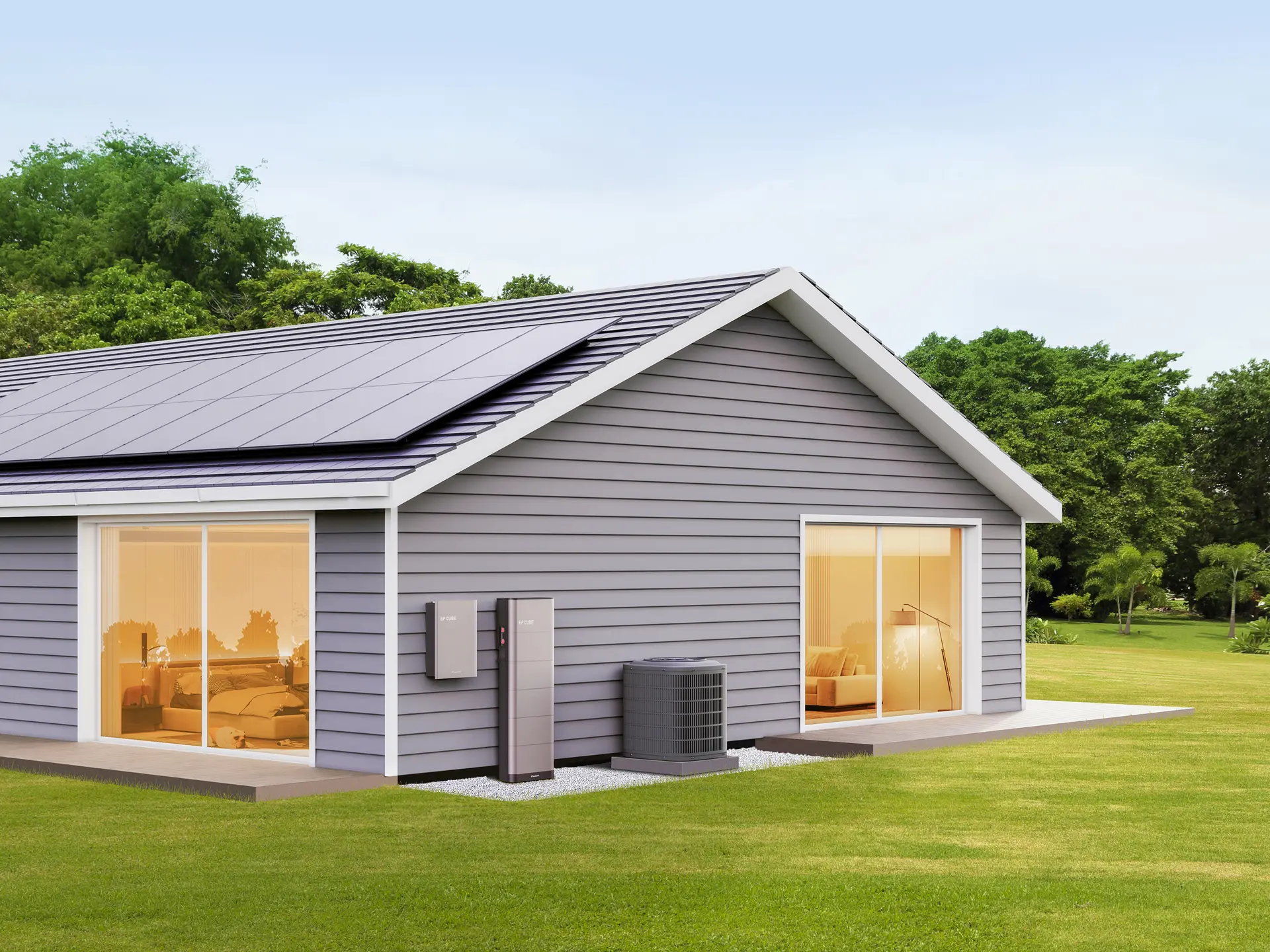
Two practical notes. The battery lives in the attached garage, inside the home's warm envelope — that's both the code-preferred location and the winter design (the full −40°C story is in Do Home Batteries Work in Alberta Winters?). And in Alberta the honest framing is resilience plus self-consumption, not rate arbitrage — there are no residential time-of-use rates to game here, and we'd rather tell you that than sell you a spreadsheet (the grid-alert deep-dive covers why resilience is the number that's been going up).
Layer 3 — The charger: the layer that replaces a gas station
The third layer turns home energy into transportation. We install two Level 2 chargers at fixed all-in prices: the Emporia Pro ($3,099 for 40A, $3,599 for 48A hardwired, + GST) — our most popular pick, with a built-in whole-home energy monitor — and the Wallbox Pulsar Plus ($3,499 / $3,999 + GST) for the premium compact form factor and voice control. Both prices include the dedicated 240V circuit, the municipal permit, the inspection, and setup; both units are rated to −30°C and deliver a full charge overnight.
The interaction that matters here is with your electrical panel. A 48A charger is an 11.5 kW continuous load — the kind of number that makes people assume a $1,500–$3,000 100A→200A service upgrade. Usually it doesn't: the 2024 Canadian Electrical Code's EVEMS provisions (Section 86) let a load-management device throttle charging whenever the rest of the house is busy, and the Emporia Pro includes exactly that. We run the actual Rule 8-200 load calculation at the assessment (the full 100A-vs-200A guide is here) and tell you which side of the line your panel is on.
And the honest version of “fuel from your roof”: at night your charger draws from the grid, but under net metering the summer credits your panels banked are paying that bill down. Sized right, the EV runs on your roof's annual production — accounting-true, and the accounting is the part that shows up on your bill.
The design order (which isn't always the build order)
When we design a complete home, the sequence is always the same:
- 1. Consumption first. Twelve months of bills plus everything you're planning to add — EV, hot tub, shop, suite. The Micro-Generation cap means the solar size is set by this number, so it has to include the future.
- 2. Battery around your critical loads. Furnace, fridge, lights, internet, sump for most homes — that list picks between 15 and 20 kWh far more reliably than any brochure.
- 3. Charger last, with load management if the panel is tight. It's the layer that bolts on most easily — if the electrical design saw it coming.
Build order can differ from design order and usually does: solar first (it pays for itself), battery second (it AC-couples onto existing solar cleanly — including systems we didn't install), charger whenever the EV lands. Staging the build is fine. Staging the design is the expensive mistake — three contractors, three site visits, three permits, and the third one discovering the first one used the panel capacity.
Planning more than one layer?
One assessment designs all three against your bills, roof, and panel — even if you build in stages. And the battery is $1,000 off bundled with new solar.
Why one crew is the feature, not the pitch
Most “complete home” quotes in Alberta are actually three companies wearing one proposal — a sales org, a subcontracted roof crew, and whoever picks up the electrical. Every handoff between them is a place where warranty responsibility evaporates.
We built the company the other way: the same in-house, Red Seal–supervised electricians install all three layers — zero subcontractors, since 2018. One crew that knows the whole design, one Master Electrician of record signing every permit, one company answerable when anything — roof penetration, backup circuit, charger breaker — needs attention in year six. It's also simply cheaper to build this way: shared engineering, shared permit trips, one mobilization, and the $1,000 battery bundle discount passes some of that back.
What the complete stack costs in 2026
| Layer | 2026 price | What's included |
|---|---|---|
| Solar (7–10 kW typical) | From $2.80/W installed — 7 kW ≈ $19,600–$24,000 · 8 kW ≈ $22,400–$27,000 | LONGi 500W + DS3 micros, engineering, all permits, net-metering paperwork, critter guard |
| EP Cube 2.0 battery | One all-in written price at the free assessment · −$1,000 bundled with new solar | Battery + hybrid inverter, install, engineering, permit and inspection |
| Level 2 charger | $3,099–$3,999 + GST, fixed | Charger, dedicated 240V circuit, permit, inspection, app + load-management setup |
Why no posted battery number? Because we won't post a price we can't honour — EP Cube 2.0 pricing is right-sized to your home and confirmed in writing at the assessment, and that number is the number you pay. Cash buyers take 10% off solar automatically; $0-down financing runs through Financeit; and the payback math on the solar layer — the one that funds the rest — is laid out in the Alberta cost guide.
The complete home, in one sentence
Panels make the energy, the battery makes it reliable, the charger turns it into kilometres — and one crew designing it once is what makes the three layers behave like one system instead of three projects. If that's the house you've been describing to yourself, the next step is a 30-minute look at your bills and your panel, and a set of real numbers on paper the same day.
Get the whole-home assessment → · Solar → · Battery → · EV chargers →
Sources: Alberta Micro-Generation Regulation (Alta Reg 27/2008) system-sizing cap; Canadian Electrical Code, 2024: Rule 8-200 load calculations and Section 86 EVEMS provisions; Canadian Solar EP Cube 2.0 North American datasheet V1.2 (output, capacity, switchover — the datasheet every spec on our battery page is checked against); CEC Rule 64-918 / Alberta STANDATA 21-ECV-064-900-ESS (battery install locations); Solar Club Alberta 2026 published rates (35.00¢ HI / 5.90¢ LO); Stellar Upgrades installed pricing and install records, Edmonton and ~200 km radius, 550+ installs since 2018. Verified August 2026.